




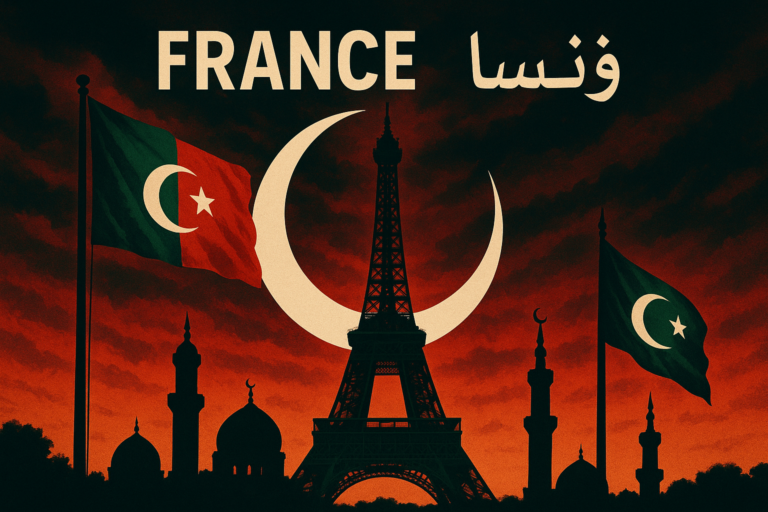
Dim Amor
A detailed report from French statistical authorities and an analysis of migration data reveal a complex demographic picture that may reshape the face of the French Republic in the coming decades. According to data available from recent years, the Muslim population of France is on a continuous upward trajectory that could bring about a profound change in the composition of the nation.
France, whose legal framework prohibits the collection of direct religious data in official censuses, relies on estimates from reputable research institutes. According to studies by the Pew Research Center, INED, and IFOP, the Muslim population in France is currently estimated at about 8–10% of the general population. However, more recent official figures point to a higher rate — 10%, based on individuals who have applied for refugee visas or other legal status in the country.
In numerical terms, this represents between 5 and 7 million people out of France’s 68 million residents. INSEE data from 2023–2024 indicate that more than 10% of the adult population in France identifies as Muslim. Pew surveys found that around 8.8% of residents were Muslim in 2016, amounting to approximately 5.7 million people.
The historical trend shows accelerated growth. In 2008, according to INSEE, about 3.5 million people in France were of Arab Muslim origin from countries such as Libya, Morocco, Lebanon, and Syria. By 2011, a study by Tribalat found around 4.6 million people of Maghrebi descent — Algerians, Moroccans, and Tunisians — including both immigrants and their descendants born in France.
The most recent data for 2025 indicates further acceleration. Partial reports suggest that the Arab Muslim population now accounts for about 16% of the total, though a full official report has yet to be published. Some claim that the real figure may reach 19%, considering statistical omissions.
Irregular migration adds another crucial dimension to the demographic picture. A report by the French Court of Auditors from the past year notes 95,200 cases of irregular border crossings at France’s external borders between January and July 2025 — an 18% increase compared to the previous year. This nationwide figure suggests an annual estimate of about 163,000 irregular border crossers. According to the report, an additional 100,000 people are still not included in official statistics, raising the total annual irregular migration figure to approximately 263,000 people.
A statistical analysis of historical trends allows projections of various scenarios for the population composition by 2070. Assuming France’s general population grows at a rate of 0.2% annually, it would number 74.8 million by 2070.
Projected Muslim population growth follows three possible scenarios:
-
Conservative scenario (2% annual growth): 31.7 million Muslims, or 42.3% of the population.
-
Moderate scenario (3% annual growth): 49.1 million Muslims, or 65.7% of the population.
-
High-growth scenario (4% annual growth): 75.9 million Muslims, or 101.4% of the total population.
According to the statistical analysis, the most realistic scenario points to an annual growth rate of 2–3%. This implies that by 2070, Muslims are expected to make up between 42% and 66% of France’s total population. It should also be noted that ongoing irregular migration significantly accelerates this trend.
To download the statistical report prepared by the “Maakav” system — click here.
The demographic shift is already reflected in political behavior. In 2025, President Emmanuel Macron posts messages on the social network X in two languages — French and Arabic. Based on current trends, the president of France in 2070 may be writing predominantly in Arabic.
The central question arising from these data is how the expected demographic transformation will affect the cultural and social identity of France. Will the traditional French nation be able to withstand the shift, or will it undergo a profound transformation that changes the country beyond recognition?
The statistical evidence underscores a clear trend: the growth rate of the Muslim population far outpaces that of the general population. Contributing factors include particularly high birth rates among Muslim families, continued migration flows — both legal and illegal — as well as family reunification policies.
Demographic research shows that France is in the midst of a historic process that could fundamentally alter its character. The Arab Muslim population, which was a relatively small minority only a few decades ago, is rapidly expanding and could become the majority by the middle of this century.
This phenomenon is sparking a broad public debate in France over the future of national identity, the preservation of the French language, the principle of secularism deeply rooted in the republic’s tradition, and the future of its education and value systems. These issues already occupy the center of political and social discourse and are expected to intensify as the demographic trend continues.
The data demonstrate that the demographic shift is no longer a distant forecast but an emerging reality, carrying increasingly profound implications for France’s political, cultural, and social life. This decades-long process may lead to a fundamental transformation of one of the European Union’s key states.