


Dim Amor
"In memory of my mother who was murdered in an attack by a 15-year-old Palestinian suicide bomber". With these words, Katia Ackerman began her post on Memorial Day, words behind which stands a story of loss, pain, and an ongoing struggle for recognition of terror orphans in the State of Israel.
On November 1, 2004, a seemingly ordinary day turned into one of those days that change the course of an entire family's life. Tatiana Ackerman, a 32-year-old young woman, went to the Carmel Market in Tel Aviv to buy basic groceries for home. The simple task—purchasing groceries at the market—ended in cruel tragedy when a suicide bomber detonated himself near where she was standing.
Tatiana was one of three people killed in that deadly attack, alongside 65-year-old Shmuel Levy from Jaffa and 64-year-old Leah Levin from Givatayim. More than 50 people were injured in the incident. Behind each of the murdered stands a moving life story, a family torn apart, and lives cut short with cruelty.
Losing a Mother to Terrorism — The Story of Tatiana Ackerman
On 01.11.2004, the Israeli police authorized the publication of the name of the third fatality in the attack that took place that morning at the Carmel Market in Tel Aviv: Tatiana Ackerman, 32, from Tel Aviv. Tatiana, a young woman with her whole future ahead of her, fell victim to a 15-year-old suicide bomber, while Katia, her 14-year-old daughter, was left motherless.
Tatiana Ackerman immigrated to Israel in 2000 from the city of Irkutsk, Russia, together with her husband and daughter. On that fateful day, she went to the Carmel Market in Tel Aviv to buy groceries. Her mother and sister remained in Russia, and the Jewish Agency offered to help bring them to Israel following the tragedy. Tatiana, a woman with a generous heart, met her death in tragic circumstances – while seeking to do good for others.
Anatomy of an Attack: The Explosion That Shocked Tel Aviv
The attack at the Carmel Market was a suicide bombing carried out by a Palestinian terrorist on November 1, 2004. Three people were murdered in the attack and more than 50 were injured. The terrorist organization Popular Front for the Liberation of Palestine claimed responsibility for the attack.
On November 1, 2004, around 11:15 AM, a suicide bomber activated an explosive device near a vegetable stand in the southern part of the Carmel Market in Tel Aviv. The explosive, which contained five kilograms of explosives hidden inside a milk bottle, resulted in the deaths of three citizens: Shmuel Levy, 65, from Jaffa; Leah Levin, 64, from Givatayim; and Tatiana Ackerman, 32, from Tel Aviv. More than 50 people were injured, including one in critical condition, six in serious condition, and the rest in mild to moderate condition.
Chief Superintendent David Tzur, then commander of the Tel Aviv District Police, stated that "it was not a large explosive, but the victims were very close to the terrorist". The explosion, which occurred near a cheese shop that was damaged but not completely destroyed, caused destruction within a radius of about four meters. Most of the nearby stalls remained intact and the merchandise on them was not damaged. Following the attack, a fire broke out, which the firefighters brought under control within minutes while helping to evacuate the injured.
The Popular Front for the Liberation of Palestine claimed responsibility for the attack and noted in its statement that the suicide bomber was Amer al-Far, an 18-year-old young man from the Askar refugee camp near Nablus. Israeli security sources determined, however, that the attacker's real age was only 15, making him one of the youngest suicide bombers during the Second Intifada.
Immediately after the attack, the police placed a cordon around the area and prevented entry to the market complex for fear of additional explosives. Security forces searched the market stalls, and dozens of police officers from the Tel Aviv district deployed in the area. A police helicopter was dispatched to try to locate the accomplices who drove the terrorist to the scene. Major traffic routes, including the HaShiv'a and Ganot interchanges on Highway 4, were closed to traffic. Reinforcements of police and military forces were called to the scene.
Three Personal Tragedies
The attack cut short three lives and wounded dozens, with a shocking human story behind each loss.
Shmuel Levy, 65, from Jaffa, had lost his son Rafi seven years earlier, who died in a car accident at the age of 26. On the day of the attack, exactly one day before the seventh anniversary of his son's death, the father was murdered. Levy came to the market with his friend, who emerged unharmed, while Levy, who absorbed the full force of the blast, was killed on the spot.
Levy had immigrated to Israel from Bulgaria with his wife and two children 15 years earlier. He worked at an electronics factory in Petah Tikva and had retired about six months before the attack.
Leah Levin, 64, from Givatayim, was a Holocaust survivor. Just four years before her death, she had the opportunity to meet her brother for the first time, on Meni Pe'er's television program. The well-known host helped bring her brother from Russia, and in the moving reunion, Leah discovered her exact age for the first time. Following the meeting, her brother immigrated to Israel with his family.
Investigation of the Attack: Failures and Cells
Merchants at the Carmel Market criticized the level of security at the location, which they described as inadequate—a situation that has not changed to this day (30.04.2025). The assessment of the Israel Security Agency (Shin Bet) was that the suicide bomber left the Askar refugee camp on the outskirts of Nablus, met his partners in Abu Dis, east of Jerusalem, and from there they continued together by car to Tel Aviv. It was revealed that the Jerusalem Police received a precise warning about the terrorist's presence in the city just ten minutes before the attack.
On November 9, 2004, information was allowed to be published about the arrest of two of the terrorist's accomplices. During their interrogation, it was revealed that the attack was originally planned to be carried out at the French Embassy in Tel Aviv. It also became clear that the explosives carried by the terrorist were originally intended for two female students from An-Najah University who had planned to carry out a double suicide attack.
Literary Prize for a Terrorist
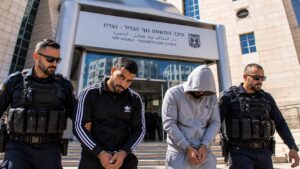
Twenty years after the deadly attack, at the end of April 2024, an event occurred that stunned many and provoked public outrage: the terrorist Bassem Hondakji, one of those responsible for the attack that cut short the life of Tatiana Ackerman and two other Israelis, won the International Prize for Arabic Fiction (IPAF) for his book "Mask, Color of the Sky", which he wrote while serving his sentence in an Israeli prison.
The prize, worth $50,000, was awarded to Hondakji despite the fact that he is incarcerated in Ofer Prison for his involvement in a deadly terrorist attack. The competition's website mentioned that Hondakji writes from within prison walls, but not a word was said about the reason for his imprisonment and the background that led to his incarceration.
On 25.04.2024, Hondakji was announced as a nominee for the "International Prize for Arabic Fiction", and on 29.04.2024, he was crowned the winner of the $50,000 prize.
Bassem Hondakji, who was 21 years old when planning the deadly attack, was nominated for the prestigious prize for his book "Mask, Color of the Sky", which he wrote from his prison cell. The international competition website does mention that Hondakji writes from within prison walls—but they refrain from mentioning the reason for his imprisonment.
The nomination itself automatically earned Hondakji a sum of $10,000, and his full win granted him the full prize amount—$50,000.
The announcement of the book's nomination was made on the program "What's Bound" broadcast on Kan Tarbut. According to the competition website, the plot revolves around an archaeologist named Nur, who lives in a refugee camp in Ramallah. Nur finds an Israeli ID card, decides to impersonate its owner to "understand the Israeli mentality", and joins a group of young archaeologists working in a settlement. The site notes that the book deals with two narratives—Nur's authentic one and that of the "mask" he wears.
Hondakji served as an accomplice to the 15-year-old suicide bomber Amer al-Far in the November 2004 attack and was responsible for transporting him to Tel Aviv. He used a journalist's credential issued to him at An-Najah University, where he studied, for free passage through IDF checkpoints. After the attack, during his journey back to the Nablus area, Hondakji was checked at a checkpoint in the Tapuach area—but he presented his journalist credential and was released.
The absurdity is striking: a person responsible for the loss of three citizens' lives and the destruction of many families is studying for an academic degree in an Israeli prison at the expense of taxpayers and wins a prestigious international prize. A surrealistic scenario that is difficult to imagine occurring in another country.
The prize funding comes from the Department of Culture and Tourism – Abu Dhabi (DCT Abu Dhabi) through the Abu Dhabi Arabic Language Centre. Additionally, the IPAF receives advice from the Booker Prize Foundation in London, although the organizations operate independently and are not directly connected.
Literature Rewarding Terrorism
The International Prize for Arabic Fiction casts a heavy shadow on the world of culture and literature because it legitimizes terrorist activity under its patronage. Behind an ostensibly respectable cultural front lies a disturbing reality where the organization gives approval to those whose hands are stained with the blood of innocent victims.
The case exposes the fundamental moral failure when a prestigious literary prize is awarded to a terrorist serving life sentences for his involvement in a deadly terrorist attack that cut short the lives of innocent citizens and left dozens wounded. In 2024, when Israeli journalists revealed to the organization's management the true identity of the nominee—a convicted terrorist imprisoned in Israel—a widespread public storm erupted. Despite the revelation and the waves of anger it provoked, the organization chose to ignore the incriminating facts and award the prize to the terrorist, showing flagrant contempt for the victims of terrorism and universal moral values.
This behavior raises pointed questions about the true identity of terrorism supporters—those who provide it with economic and symbolic patronage.
The International Prize for Arabic Fiction (IPAF) is considered one of the most prestigious prizes in the world of Arabic literature. It was founded in 2007 in Abu Dhabi, under the pretext of promoting outstanding works in modern Arabic prose and expanding their international reach through translations.
The organization is registered in England and Wales under number 6679925. The award ceremonies are held in Abu Dhabi, and it is reasonable to assume that the organization maintains representation in the United Arab Emirates and London.
Embracing Terrorists — Betrayal of Victims
No less serious than international recognition of a terrorist is the backing he receives from official Israeli sources. While innocent citizens are murdered, terrorists receive visits from serving members of the Knesset.
As journalist Shai Friedman published on 29.07.2020: "We can also remember that MK Touma Suleiman went to visit Bassem Handakji of the Popular Front in prison; true, he didn't participate in fights, he only commanded a suicide bombing in the Carmel Market in which 3 Israelis were murdered. With this murderous fascist, she has no problem meeting".
Indeed, in 2016, MK Aida Touma-Suleiman (Hadash) paid a visit to Handakji in prison. The visit provoked sharp public criticism, especially from political figures on the right, who accused her of supporting terrorists. Touma-Suleiman claimed on her part that the visit was intended to monitor the conditions of Palestinian prisoners and protect their human rights.
The visit created a storm in the political arena. MK Amichai Chikli (Likud) claimed that Touma-Suleiman supports terrorist organizations like Hamas and Hezbollah, and expressed firm opposition to her presence in the Knesset. In response, Touma-Suleiman claimed that she opposes harm to civilians from any side, and that her visit was only intended to promote human rights and not to support terrorism.
Naftali Bennett, then a member of the Knesset, responded sharply: "Hundreds of visits by Knesset members from Arab parties to murderers of Israeli men, women, children, and babies is a moral atrocity for the State of Israel and the Israeli Knesset. These are arch-murderers of the worst kind. The waving of 'human rights' and 'freedom of movement' by lawyers is absolute nonsense in the face of the moral stain and deterrent damage. This is not how to govern".
MK Touma-Suleiman, whom her critics accuse of honoring terrorists and supporting them, continues to serve in the Knesset and receive a salary from Israeli public funds. The absurdity is particularly striking considering the fact that in many other countries, people who express support for terrorism or maintain contact with terrorists are not allowed to participate in elections at all.
In Israel, Section 7A of the Basic Law: The Knesset, stipulates that a candidate or list cannot run for the Knesset if their objectives or actions include:
- Denial of the existence of the State of Israel as a Jewish and democratic state
- Incitement to racism
- Support for armed struggle of an enemy state or terrorist organization against the State of Israel
Apparently, according to the provisions of the law, many Knesset members should not have been allowed to run for elections.
It is interesting whether the Shin Bet and the police occasionally check the profiles on the X network of Knesset members who seem to be identified with supporters of terrorists—for example, Knesset members like Ahmad Tibi, Ayman Odeh, and Aida Touma-Suleiman continue to act freely against the State of Israel, shamelessly humiliate IDF soldiers and security forces, call the government criminal, and write about Minister Ben-Gvir as a terrorist.
Just recently, MK Tibi compared MK Moshe Saada to a Nazi, despite the fact that their social networks are sometimes characterized by what is perceived by many as incitement against the State of Israel. All this takes place under the umbrella of democracy and freedom of expression.
The gap between the standards in Israel and those accepted in other Western countries is enormous. It is difficult to imagine a situation where an American congressman systematically visits terrorists who murdered American citizens, but in Israel, this phenomenon exists alongside the concern of elected officials for the detention conditions of those who murdered Israeli citizens.
Katia Ackerman: Fighting for Terror Orphans
Against the backdrop of all of the above, the noble and lofty struggle of Ms. Katia Ackerman, daughter of the late Tatiana, may her memory be blessed, stands out.
Ackerman, a dedicated social activist who specialized in the art of acting and realized her civic affinity through service in the police as an alternative to the military track, is a patriotic personality imbued with deep love for the State of Israel. Beyond that, she dedicates a significant part of her precious time to humanitarian activity for animal rescue. Her figure reflects an alert and involved personality in the social reality, holding a broad heart overflowing with compassion and human warmth.
In an interview she gave to "Ma'akav" magazine, Ms. Ackerman revealed a jarring and outrageous paradox in Israeli state policy: orphans of hostile acts do not receive proper and worthy institutional support, while spouses of victims of terrorist acts receive comprehensive and deep support and guidance.
Ms. Katia Ackerman held meetings with official and senior figures, including elected officials from the legislature, managers of relevant organizations, and conducted in-depth conversations with representatives of the National Insurance Institute (including documented correspondence), but to no avail and with no tangible results—the National Insurance Institute does not provide proper and worthy recognition to terror orphans or to descendants whose parents lost their lives in hostile terrorist acts.
The National Insurance Institute transferred payments to perpetrators of terrorist acts (until March 31, 2025) and to this day to parents who raised terrorists, and recognizes the rights of perpetrators of terrorist acts, but systematically ignores the rights of orphans of hostile acts.
For many long years, Ms. Ackerman has been tirelessly fighting to raise public awareness of the severe and unbearable plight of orphans or children whose parent fell victim to an attack or a security incident on a nationalist background. She stands firm in her belief in their basic and unshakable right to state support, and strongly negates the institutional disavowal and bureaucratic abandonment. However, unfortunately and painfully, her righteous voice remains like a voice crying in the wilderness.
Historic Move
It should be emphasized that only in March 2025 (31.03), the Knesset plenum approved in second and third readings the bill designed to deny National Insurance benefits to terrorists who have been convicted. The law, initiated by the Coalition Chairman, MK Ofir Katz, cancels eligibility for benefits from the state treasury for those convicted of severe terrorist offenses.
Until the current legislation, convicted terrorists enjoyed eligibility for a wide range of benefits from the National Insurance Institute, including: disability benefits, nursing benefits, birth grants, maternity allowance, survivors' benefits, savings plan for every child, child allowance, burial expenses, unemployment benefits, and additional grants. According to professional estimates, the total payments could reach thousands of shekels each month.
In addition, the new law also cancels the possibility for family members of the terrorist to receive income assurance as a result of his imprisonment, a benefit that had been in effect until now. The approved legislation establishes an absolute and comprehensive denial of all benefits from terrorists convicted of murder, attempted murder, and other serious terrorist offenses.
Following the approval of the law, MK Ofir Katz stated: "The reality that existed until now, where a terrorist who murdered a Jew was entitled to receive money from the treasury of the State of Israel—is a delusional and inconceivable reality. We have brought an end to this madness. The important bill that I initiated has been approved, and from now on, a terrorist will not receive even one shekel from the state treasury".
Supreme Court to Reconsider: Pay Terrorists?
The law to deny National Insurance benefits to terrorists, which was approved by the Knesset plenum in March 2025, is expected to face judicial review by the High Court of Justice. Legal sources estimated that the law might encounter constitutional obstacles, especially with regard to fundamental rights and the principle of equality before the law. The legal advisor to the Knesset also expressed his reservation about the law, fearing its legal implications and the High Court's determinations.
In light of the objections in the legal and public spheres, it is reasonable to assume that the law will be brought for examination before the High Court in the near future.
In addition, the law to deny National Insurance benefits to terrorists, which was approved in the Knesset on the thirty-first day of the month of Adar II 5785, was passed by a majority of thirty-four supporters against two opponents. Despite the broad support, there were Knesset members who expressed their opposition to the law.
For illustration, in the past, a similar law was enacted regarding Arab terrorists under the age of 18, when the Knesset determined that the parents of terrorists would not receive benefits from the National Insurance, but thanks to a lawyer of Hebrew origin with Israeli citizenship, a petition was submitted to the High Court—and the High Court ruled that the National Insurance is obligated to pay benefits to parents of terrorists (note—an Israeli court determines that parents of terrorists should receive money, meaning apparently a bonus for the attack—it's worth killing Jews—if that's how it is).
And of course, there is no shortage in Israel of Hebrew-Israeli lawyers who, for the purpose of the matter, are sympathizers of terrorists, who will likely make every effort so that terrorists receive benefits and the law is canceled, with reference to the new law from 31.03.2025, the law to deny National Insurance benefits to terrorists.
The High Court's Decision to Cancel the Law Denying Benefits from Parents of Minor Security Prisoners
On July 8, 2021, the High Court accepted a petition from the Adalah Center and canceled a law that allowed the denial of National Insurance benefits from parents of minors who were imprisoned for security offenses. The law was perceived as violating the principle of equality, as benefits are not denied from parents of minors imprisoned for other criminal offenses.
The ruling, which was accepted by a majority of five against four, determined that the amendment to the law disproportionately violates the constitutional right to equality, and froze the law for a year to allow the Knesset invitations to correct the flaws in it.
HCJ 3390/16 Adalah – The Legal Center for Arab Minority Rights in Israel v. The Knesset.
Attorney Sawsan Zaher from the Adalah Center stated in response to the ruling: "It is clear that there is no constitutional possibility to anchor this vindictive tool in a law that produces one law for Palestinian minor prisoners and another law for minor prisoners in the criminal process".
For example, a 15-year-old terrorist who took the life of Tatiana Ackerman and two other victims, and left more than fifty people injured (had he remained alive, his parents would have received monetary compensation from the treasury of the Jewish state), in addition, as of April 2025, 9,792 security prisoners are held in detention facilities in Israel, constituting about half of all prisoners in the country. Among these, about four hundred are minor terrorists who have not yet reached the age of eighteen.
(As of April 2025, the total number of detainees in detention facilities in Israel stands at about 22,874, of which about 9,792 are security prisoners)
Pain That Does Not Heal
Twenty years have passed since that terrible day at the Carmel Market, but the pain and loss remain fresh. For Katia Ackerman, Memorial Day symbolizes not only her personal loss but also the ongoing struggle for recognition and appreciation for terror orphans in Israel.
"In memory of my mother who was murdered in an attack by a 15-year-old Palestinian suicide bomber". The words with which Katia opened her post on Memorial Day echo not only as a personal memory of a daughter for her mother but as a reminder to the entire Israeli society of its moral debt to those who lost their loved ones to terrorism, especially those who were left orphans at a young age.
Tatiana Ackerman, of blessed memory, left behind a legacy of love and compassion, which is expressed today in her daughter's struggle for other children who have experienced similar loss. While terrorists and their supporters sometimes receive recognition and support, Israeli society has the obligation to ensure that victims of terrorism and their families are not forgotten, and receive the support and recognition they deserve.