





Dim Amor
In a significant development reverberating across the international arena, the President of Ukraine, Volodymyr Zelenskyy, has signed a sweeping amendment to his country’s criminal code, establishing, for the first time, explicit criminal liability for manifestations of antisemitism. The measure, widely praised by Israeli officials, marks a turning point in Ukraine’s efforts to combat hate crimes and to entrench values of tolerance within Ukrainian society.
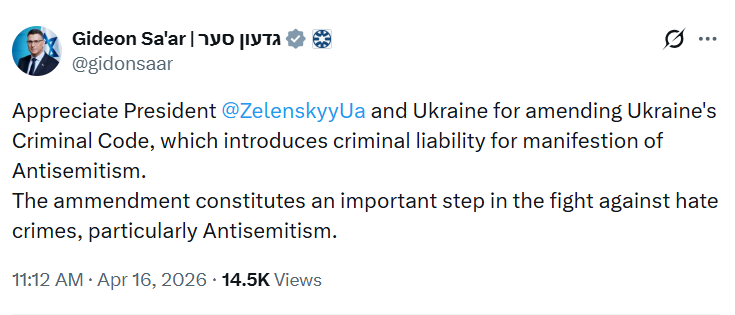
Israel’s Minister of Foreign Affairs, Gideon Sa'ar, welcomed the move and underscored its importance: "I express my appreciation to President Volodymyr Zelenskyy and to Ukraine for the amendments to the criminal code, which impose criminal liability for manifestations of antisemitism. These amendments constitute a necessary and significant step in the fight against hate crimes, particularly antisemitism, and reflect Ukraine’s commitment to safeguarding human rights and promoting the values of tolerance".
An Unprecedented Delay
Despite its public and moral significance, the path to enactment was marked by notable irregularities. The amendment to the criminal code was approved by the Ukrainian parliament, the Verkhovna Rada, on February 15, 2022, just one week prior to Russia’s full-scale invasion. However, President Zelenskyy’s signature was delayed for an extraordinary period of four years and two months. Such a duration represents an exceptional anomaly in legislative processes of this kind, with the law remaining in the presidential office without formal enactment until only recently.
The legislative process had begun earlier, in February 2021, with the introduction of two bills addressing the prevention of and response to antisemitism. While the general law on preventing and combating antisemitism was approved and signed as early as October 2021, the criminal amendment, designed to ensure enforcement, remained pending until now.
The Penalty Framework: From Fines to Imprisonment
The amendments anchor the fight against antisemitism within Article 161 of Ukraine’s criminal code, which addresses violations of equal rights on the grounds of race, religion, or nationality. The law establishes a graduated scale of penalties based on the severity of the offense:
Basic offenses: fines ranging from 3,400 to 8,500 hryvnias, or restriction of liberty for a period of three to five years.
Aggravated offenses (including violence, threats, or acts committed by public officials): increased fines of up to 17,000 hryvnias or imprisonment for two to five years, accompanied by disqualification from holding certain positions.
Offenses committed by an organized group: imprisonment for five to eight years.
Defining Hatred
The law provides a detailed definition of prohibited manifestations of antisemitism. These include:
Denial of the Jewish people’s right to self-determination.
The dissemination of false stereotypes and the imposition of collective responsibility upon the Jewish community.
Holocaust denial or justification.
Incitement to violence against Jews.
Vandalism, desecration of cemeteries, and damage to religious sites and public institutions.
The production and distribution of symbols or content that incite hatred.
A Strategic Perspective: A National Home for Every Jew
While Ukraine’s legislation is welcomed as a legal instrument within its jurisdiction, public discourse in Israel emphasizes that the future and security of the Jewish people do not rest on foreign statutes, but rather on the existence of the State of Israel itself.
As a sovereign, prosperous, and powerful nation, Israel places the protection of the Jewish people at the forefront of its national mission. A central pillar of this doctrine is the Law of Return, enacted in 1950, which grants every Jew the right to immigrate to Israel and establish residence as part of the Jewish people’s national home.
The law confers immediate eligibility for Israeli citizenship upon every Jew, as well as their children, grandchildren, and spouses. The existence of the state, together with the defensive capabilities of the Israel Defense Forces, provides a firm assurance that Jews are no longer dependent on external actors, but instead benefit from a strong protective state, one that combines a dynamic economy with substantial military power, ensuring the resilience and continuity of the Jewish people at all times.
Postscript
In a world where millions are displaced and compelled to seek refuge beyond their homelands, the State of Israel stands as a definitive historical reality, at times even a disquieting one for its detractors: there are no longer, and will not again be, Jewish refugees in the classical sense.
In many countries, including Ukraine, individuals of a given national origin born outside the state’s borders are not entitled to automatic citizenship solely on the basis of their identity. Israel, by contrast, presents a unique and exceptional model. Through its founding principles, the Law of Return enshrines a clear doctrine: a Jew is a Jew, irrespective of birthplace, circumstances, or the path that led them to the country’s gates.
The State of Israel opens its doors to every Jew and their family members in accordance with the Law of Return, granting immediate civil status alongside a comprehensive integration framework that includes financial assistance, social support, and guidance during the initial years of settlement. In addition, a limited and distinct recognition is afforded to non-Jews who risked their lives to save Jews during World War II, those recognized as the Righteous Among the Nations, who, in certain cases, may receive special status and pathways to regularizing their presence in Israel.
In a global reality where many refugees must navigate complex bureaucratic systems and often depend on the discretion of host states, Israel provides a clear and unequivocal address for Jews worldwide. For many, it represents not merely a political framework, but a profound anchor of identity and security.
For hostile actors, this reality likely embodies a dramatic historical shift: the Jewish people, once compelled to wander and seek refuge, have established enduring national sovereignty, a framework in which national identity is no longer a cause for persecution, but rather a foundation for security, liberty, and continuity.
Photo credit: Volodymyr Zelenskyy (AP); Gideon Sa'ar (Knesset website); Tel Aviv – "Maakav".