

Dim Amor
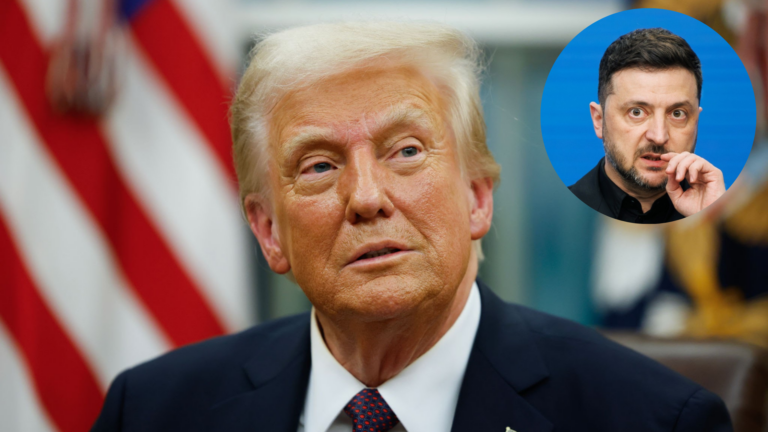
The President of the United States, Donald Trump, has asserted that Ukraine’s offers of assistance to countries in the Middle East are, in his view, intended solely for public relations purposes. His remarks are directed at Ukrainian President Volodymyr Zelensky, amid ongoing discussions regarding Kyiv’s involvement in security arenas beyond its borders.
Trump characterized the assistance provided by Ukraine to U.S. allies in the Middle East as a politically driven, image-oriented initiative rather than one of substantive operational significance. According to journalist Stephanie Ruhle, who conducted an approximately 15-minute phone interview with him, as reported by a Ukrainian news outlet, Trump was asked about Ukraine’s contribution to efforts supporting U.S. allies in the region, particularly in countering Iranian-made unmanned aerial vehicles.
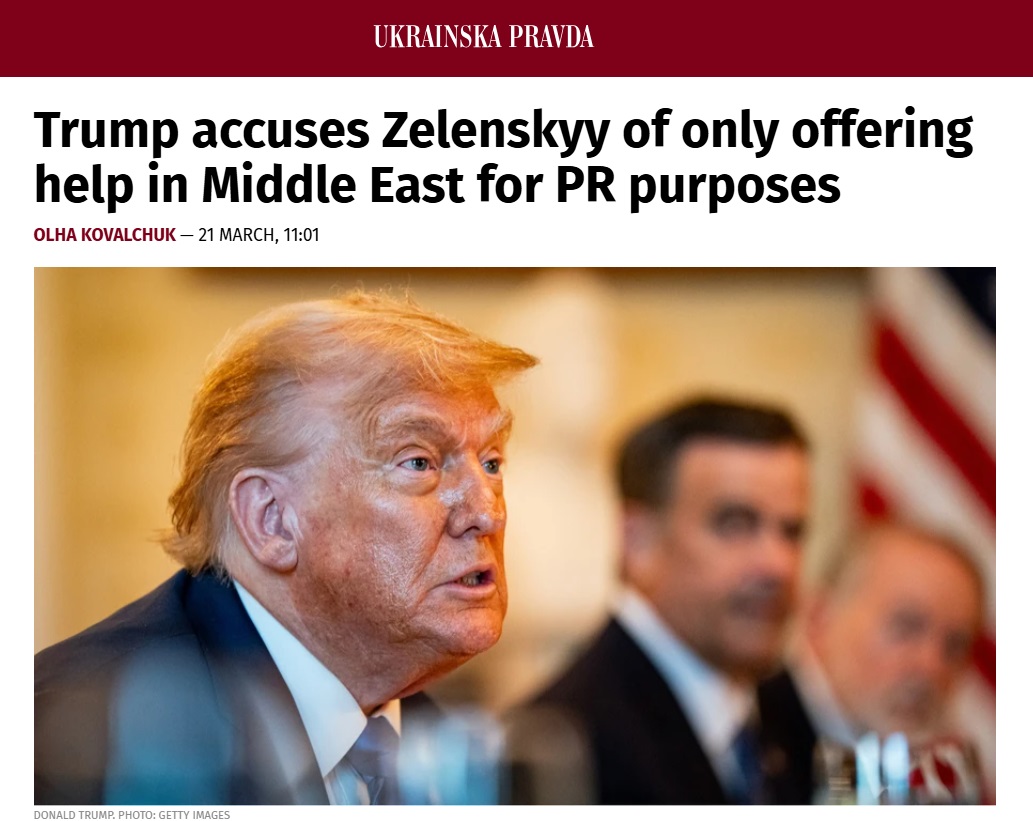
According to her account, Trump responded that Ukraine "has done nothing", adding that all statements made by Zelensky on the matter are, in his view, aimed at political objectives and serve public relations purposes. In doing so, Trump sharpened the line of criticism he has recently maintained toward Ukraine’s leadership.
In his subsequent remarks, Trump reiterated personal criticism of Zelensky, stating that he is "more difficult to deal with" than Russian President Vladimir Putin. He further added that the Russian leader, according to him, "is not afraid of Europe" – a statement reflecting his perception of the current balance of power.
Additionally, Trump expressed dissatisfaction with the conduct of NATO member states, asserting that they are not assisting the United States in its operations against Iran. Nevertheless, he emphasized that Washington does not, in practice, require their assistance, despite expectations of cooperation among allies.
The context of these remarks is further underscored by a prior statement made by Trump on March 13, in which he emphasized that the United States does not require Ukrainian assistance in intercepting Iranian drones in the Middle East. In response, Zelensky stated that "rhetoric is rhetoric", adding that "what matters is that we know what we are doing" – a remark suggesting a gap between public statements and actual operational activity.
Meanwhile, last week, U.S. Army Secretary Dan Driscoll reported that American forces had deployed approximately 10,000 interception drones of the "Marops" type across the Middle East – systems that previously demonstrated operational effectiveness in the Ukrainian theater and are now integrated into broader air defense frameworks.
At the same time, a more direct and pointed formulation presented within the public discourse has intensified criticism of the Ukrainian president: Zelensky claimed that the United States and Israel had requested his military support – a claim which, as asserted, is known in both Israel and the United States, yet constitutes a blatant falsehood. Following what is described as a misleading presentation to the public, it is alleged that the Ukrainian president now seeks to secure a more serious and respectful standing on the international stage.
In this context, a broader question arises regarding Ukraine’s diplomatic conduct at present: to what extent do public statements reflect actual policy, and what are their implications for the country’s foreign relations. Against this backdrop, the war in Ukraine continues, while the international community closely monitors developments across both the political and security domains.
Zelensky and Diplomatic Falsehood: The Drone Affair
On March 20, 2026, the Maakav editorial team documented an incident it described as a serious case of misinformation, in which it was claimed that Ukraine’s ambassador conveyed information inconsistent with reality – namely, that Israel’s Prime Minister had approached, or intended to approach, Ukraine for military assistance. According to the report, this claim was defined as misleading the public.
The article further presents Israel as a state possessing advanced military capabilities, which under certain circumstances could achieve rapid military outcomes, while, in contrast, Ukraine is described as facing significant systemic shortcomings at both governmental and military levels.
In essence, the report published on the Maakav website advances claims that a Ynet article – which addressed an alleged Israeli request to Ukraine for drone-related assistance – does not reflect factual reality. According to the account, Israeli Prime Minister Benjamin Netanyahu was attributed with making such a request to President Zelensky; however, the article asserts that official sources in Israel categorically denied this claim.
The report also includes a quote attributed to a diplomatic representative at Ukraine’s embassy in Israel, stating that the drone issue “was entirely fabricated.” On this basis, the article frames the episode as a substantial media failure, emphasizing the discrepancy between the original publication and the information presented as an official denial.
In conclusion, Maakav presents the episode as part of a broader pattern of disseminating unsubstantiated information within the media sphere, emphasizing that such publications may carry significant implications for public discourse and foreign relations. It further noted that the editorial team will continue to monitor publications with the potential to influence perceptions of factual reality.
Photo: AP – used in accordance with Section 27A of the Copyright Law