




Dim Amor
The "Maakav" editorial team conducted a survey of the Hanukkah 2025 doughnut market and discovered: Israeli gullibility knows no ceiling, and consumers continue to pay gold prices for fried dough. In the case of the Roldin chain, the price for a single pastry reaches 20 shekels, a figure that transforms the doughnut from a popular festive product into an unjustified luxury item.
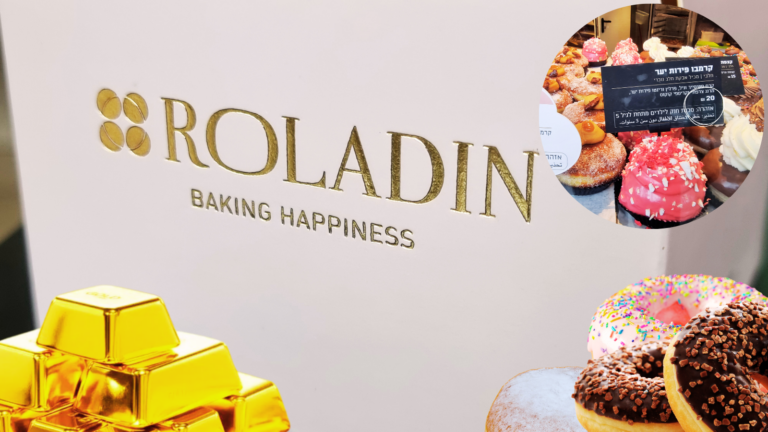
The visit took place at one of Roldin's central branches, where the average doughnut price hovers around 18 shekels per unit. While relatively "cheap" doughnuts at 16 shekels do exist, it's precisely the flagship model – the one displayed at the front of the counter and in the marketing campaign – that stands at 20 shekels. Again, shamelessly, the unit sells for 20 shekels, without explanation, without justification, and without any real quality or nutritional advantage.
The experiment we conducted was simple: purchasing one doughnut at full price to understand with our own eyes what exactly we're dealing with. The result? A completely ordinary doughnut with standard taste, filled with milk jam and basic decoration. The box, however, was incomparably more impressive, and it seems that it's precisely the gold-plated lettering that contributed to the 20-shekel price per unit, which is otherwise difficult to justify.
The tasting revealed excessive greasiness, an oily cream coating that was more disgusting than pleasant, and a general feeling that the world has become an illogical place.
It's important to emphasize here: this is not a high-end bakery, not a famous chef's restaurant, and not a boutique brand. This is Roldin café, an ordinary commercial chain. If so, what justifies the price?
To understand the true significance of 20 shekels for a doughnut, we performed a simple calculation. An average doughnut weighs about 100 grams. When its price stands at 20 shekels per unit, the picture becomes clear: a kilogram of doughnuts costs approximately 200 shekels. This is not rhetorical phrasing or wordplay – this is a dry mathematical calculation.
And here begins the disturbing comparison. The price of one gram of 18-karat gold today ranges between 310 and 350 shekels on average. The meaning is clear: a kilogram of doughnuts costs about two thirds the price of a gram of gold. In terms of price per weight, a Roldin doughnut approaches precious metal territory.
Of course, no one claims the doughnut is made of gold. It has no commercial value, no financial worth, and no industrial value either. But in pure consumer terms, we're dealing with a very expensive product relative to its weight, its limited nutritional value, and the raw materials that comprise it: flour, oil, sugar, cheap synthetic filling, and yeast. These are basic products with relatively low production costs, even when prepared with quality.
So why do consumers continue to buy? The answer is simple: because they buy. Chains like Roldin wouldn't price the doughnut at 20 shekels if there weren't demand.
The suckers, apparently, never run out. If consumers revolted or refused to pay, the chains would be forced to lower prices or get rid of the doughnuts. But Israeli reality is different: while average wages stand still, prices soar, and the public continues to buy as if this were an essential commodity.
There's a broader phenomenon expressed in the expensive doughnut: normalization of excessive prices through "tradition," "seasonality", and attractive marketing packaging. Every year we tell ourselves it's just Hanukkah, only once a year, so let's indulge. The chains know this and exploit that emotion aggressively. They dress the doughnut in a designer box, add a fancy name like "premium doughnut" or "royal doughnut", and price it as if it were a luxury product.
The gap between the public image of the doughnut as a popular festive pastry and its actual price grows enormous year by year. What was once a symbol of simplicity and joy has become an industrially recycled product whose price is disconnected from cost and value. It's no longer "Hanukkah pastry" – it's merchandise priced according to what the consumer is willing to pay, not what it's worth.
Roldin is not an exception. Other chains like Café Greg, Aroma, Café Café, and Cofix also sell doughnuts at prices ranging from 12 to 20 shekels, with the average continuing to rise. This is an entire industry that understood enormous profits can be made on a product that consumers buy out of emotion, habit, and social pressure.
The conclusion is not dramatic, but it is sharp and clear: even at a price of 20 shekels per unit, a kilogram of doughnuts approaches the price of a gram of gold, not because of their value, but because of the excessive price set for them. This is no longer a "funny statistic" or Hanukkah joke. This is a cold consumer figure testifying that the Israeli market has lost all proportion, and consumers continue to pay without real protest.
Ultimately, the fact that a doughnut can be sold for 20 shekels teaches more about the economic and cultural situation in Israel than about the doughnut itself. As long as the public continues to buy, prices will continue to rise. There's no higher power here that will stop the phenomenon, only the consumers themselves can do so by voting with their wallets. But as long as the line is long and the counter is full, Roldin and its companions can continue to price the doughnuts as if they're gold plated.
Photo: Maakav