


Dim Amor
While Eilat authorities publicize achievements and innovative projects, a new State Comptroller's report reveals a completely different reality: only 8 percent of government decisions for the city's development are being fully implemented. The data, published during the Iron Swords War, raise serious questions about the gap between official declarations and ground reality.
The report, compiled against the backdrop of intensifying security threats to Eilat and the need to strengthen its economic resilience, points to a systemic failure in the city's development. Despite significant government decisions made in 2019 and 2022, two-thirds of the designated actions were not carried out or were only partially implemented.
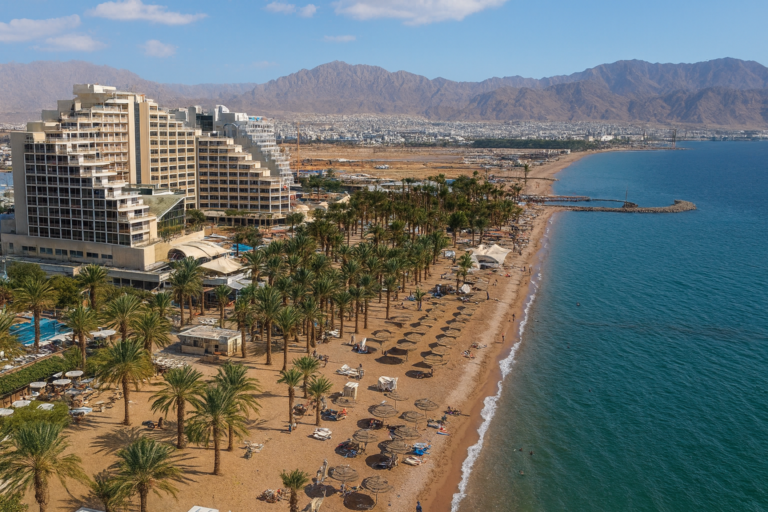
The findings are particularly concerning given Eilat's absolute dependence on the tourism industry. As emerges from the report, the lack of economic diversification left the city exposed to risks during emergency situations, exactly as occurred with the outbreak of the Iron Swords War when the tourism industry collapsed almost completely.
Data from the report indicate a deeper problem. Of 50 million shekels the government decided to allocate for assistance to the city's tourism industry during the war, 25 million shekels were not allocated at all. The remainder was allocated with significant delays, severely damaging the tourism industry's ability to recover economically during the coming period.
The criticism focuses on three main areas: the Ministry of Tourism's preparedness for emergency assistance, the actual aid provided to Eilat's tourism industry after it was damaged in the war, and strengthening the city's tourism industry alongside developing additional economic anchors. In each area, significant gaps were found between planning and execution.
Simultaneously, Eilat authorities continue to announce various initiatives and projects. In March 2024, an innovation and entrepreneurship center was launched in the former terminal building, featuring workspaces and podcast rooms designed to promote technological entrepreneurship in the city. The municipality also invested approximately 10 million shekels in summer renovations of educational institutions, including upgrading classrooms and courtyards.
In the security realm, the municipality approved the establishment of a municipal security patrol that will operate 24 hours a day in three shifts. The patrol will comprise 27 patrolmen from Eilat residents who are veterans of security units. Additionally, approximately 650 municipal cameras were installed and the establishment of a new fire station in the police district was discussed.
However, the report places these announcements in a different perspective. According to the findings, the Ministry of Tourism was not prepared for emergency situations and failed to provide a rapid and efficient response to damage to the tourism industry. The gaps in preparedness impaired its ability to provide an adequate response to the city when the war broke out and tourism ceased almost completely.
The picture becomes sharper when examining the broader context. Immediately after the October 7 terrorist attack, Eilat municipality, its residents, and the city's hotels mobilized extensively to assist tens of thousands of evacuees from the south and north, doubling the city's population. Assistance was provided in various areas including housing, health, welfare, and education, making Eilat a symbol of mutual responsibility and national commitment during emergency.
Precisely in light of this mobilization, the gaps revealed in implementing the city's development decisions raise much greater concern. The report emphasizes that correcting deficiencies and implementing recommendations are important for the State of Israel as a whole, given the intensification of security threats to the state and to Eilat, and the city being a central component in the strategic-national response to emergency situations.
The solutions proposed in the report include immediate action by the ministers of tourism, finance, health, economy, and agriculture to implement government decisions according to their areas of responsibility. The goal is to exhaust the national potential inherent in the Eilat region and strengthen its economic and tourism resilience in routine and emergency times, especially given the growing competition with resort destinations in other countries.
The municipality's budget for 2025 was approved at 736 million shekels, with emphasis on education, infrastructure, and upgrading veteran neighborhoods. In education, a tender was published for establishing a high school in the Shahamon neighborhood, outstanding institutions in the southern district were declared, and scholarships were distributed to Eilat resident students. The 5786 academic year opened with 11,500 students and the absorption of 72 new teachers.
However, despite the investments and initiatives, the central question arising from the report remains without adequate answer: how to ensure transition from declarations to actual implementation. The 92 percent gap between decisions and full implementation indicates a structural problem requiring urgent and comprehensive treatment.
The State Comptroller calls on relevant parties to act with a broad forward-looking perspective, strategic vision, and in accordance with government decisions made over the years. Emphasis is placed on the need to diversify the local economy and reduce the almost absolute dependence on the tourism industry, which proved particularly vulnerable during crisis.
Time will tell whether these calls will be realized into concrete steps on the ground, or whether the gap between decisions and execution will continue to widen, leaving Eilat exposed to additional risks in the future.