



Dim Amor
A sharp diplomatic crisis erupted this week between Israel and Spain following statements by Spanish Prime Minister Pedro Sánchez, which Israeli officials interpreted as a veiled nuclear threat. Israeli Foreign Minister Gideon Saar leveled serious accusations at Sánchez, while an anti-Semitism organization is calling for an investigation of the Spanish Prime Minister for alleged incitement to genocide.
The crisis began when Sánchez made statements at a press conference dealing with the adoption of sanctions against Israel. During the statement, Sánchez said that "Spain, as you know, does not have nuclear bombs, aircraft carriers or large oil reserves. Alone, we cannot stop the Israeli attack. But this does not mean we will stop trying, since there are battles worth fighting for, even if their victory is not in our hands alone".
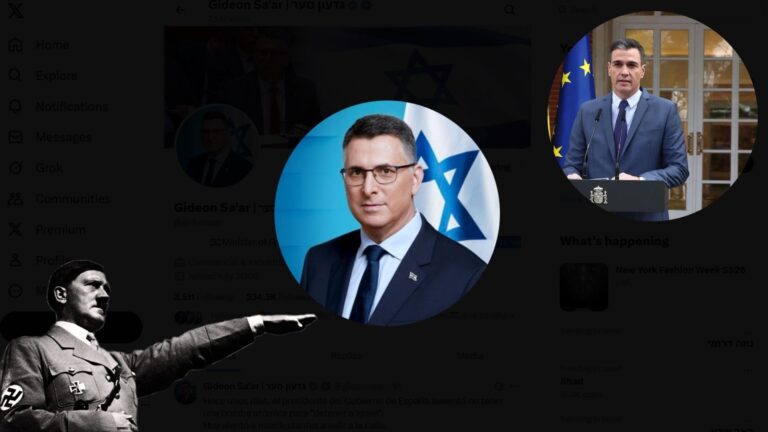
The Israeli response was not long in coming. Foreign Minister Gideon Saar published a sharp statement on the social network X, in which he accused the Spanish Prime Minister of dangerous incitement. "A few days ago, Spain's Prime Minister expressed regret that he does not have an atomic bomb 'to stop Israel'", Saar wrote. "Today he encouraged protesters to take to the streets. The pro-Palestinian mob heard the incitement messages and disrupted the 'La Vuelta' bicycle race. Thus a sporting event that was always a source of pride for Spain was canceled. Sánchez and his government – a disgrace to Spain!".
The Movement to Combat Anti-Semitism, an international organization active in the fight against hatred of Jews, responded more dramatically. The organization published an official call to investigate Sánchez under international legal conventions, while accusing him of incitement to genocide. The organization's CEO, Sacha Roytman, leveled serious accusations at the Spanish Prime Minister.
"These disgusting and inciting statements brutally tore the mask from the face of Prime Minister Sánchez, who pretends to act from humanitarian motives, while his hidden desire appears to be a military attack on Israel, to the point of using weapons of mass destruction", Roytman declared. He added that Sánchez thereby joins "the shameful club of those who yearn to use nuclear weapons against Israel".
Roytman compared Sánchez's words to previous statements by other figures who made nuclear threats against Israel. Among these he mentioned Palestinian Authority senior Jibril Rajoub, who previously declared that "if we had nuclear weapons, we would use them", as well as a former Iranian president who said that "Israel is a one-bomb state".
According to Roytman, this is "nothing less than an aspiration for genocide, which will gladden a call to extremists throughout the region, who dream of Israel's final destruction by any possible means". He called on Sánchez "to immediately renounce these murderous words, to apologize unreservedly and to pray that his words will not arouse additional bloodshed".
The controversy reached its peak when Roytman called on international legal bodies "to examine whether there are grounds to accuse him of incitement to genocide" if Sánchez does not apologize for his words. This is a serious accusation at the international level, indicating the depth of the diplomatic crisis that has been created.
The tension between Israel and Spain did not begin this week. Spain is one of the leading countries in Europe in criticism of Israel's actions, and it is among the first to recognize a Palestinian state. The Spanish government supports imposing sanctions on Israel and operates at the European level to increase international pressure on the Israeli government.
Sánchez's recent statements are perceived in Israel as particularly extreme. The Israeli interpretation of his words presents them as an expression of a desire to destroy Israel by extreme means, although a look at the full context of the statement might lead to a different interpretation.
At the press conference, Sánchez explained the limitations facing Spain in its ability to influence the situation. He noted that his country lacks the military and economic tools required to exert effective pressure on Israel, but emphasized that it will continue its attempts nonetheless. The Israeli interpretation of these words is that Sánchez expressed regret that Spain does not have more extreme military means.
The controversy is receiving wide resonance in the international community, with various parties expressing concern about escalation in diplomatic language. The Israeli claims regarding incitement to genocide place these statements in a dramatic place in the context of international law.
Indeed, the issue takes on an additional dimension in light of the events described by the Israeli Foreign Minister. According to Saar, the Spanish Prime Minister's statements led to demonstrations and the cancellation of a prestigious sporting event. The "La Vuelta" bicycle race, one of Spain's major sporting events, apparently encountered disruptions or was canceled as a result of pro-Palestinian demonstrators' activity, according to Saar's claims.
In Israel, this is seen as an example of how extreme political statements can lead to street violence and damage to civilian events. The claim is that the harsh language of political leadership encourages extremists to action, even when this was not the original intention.
The crisis places both countries in a diplomatically complex situation. Spain, as a member of the European Union and NATO, maintains complex relations with Israel regarding the Israeli-Palestinian conflict issue. On the other hand, Israel is forced to deal with growing criticism from traditional allies in Europe.
Whether Sánchez's statements indeed constitute incitement, as claimed by sources in Israel, or whether this is an excessive interpretation of his words – this issue remains controversial. Now the international legal bodies, to which the CAM organization has appealed, will be required to decide whether there is a legal foundation for investigation, or whether this is merely a political dispute, worthy of clarification through diplomatic channels.
The current crisis illustrates the growing complexity in Israel's relations with European countries, and the intensifying difficulty in maintaining diplomatic dialogue on sensitive issues. In addition, it raises pointed questions regarding the legitimate boundaries of expressing sharp political positions in the international arena, and the possible consequences of using extreme diplomatic discourse.
Photo: Presidential Office, Government of Spain. Photo of Gideon Saar, from the official X network