


Dim Amor
Special Report: A turbulent night of relentless fighting between Russia and Ukraine unfolded across multiple fronts, as a wave of reciprocal drone attacks inflicted widespread damage on critical infrastructure, caused extensive destruction to residential buildings and left numerous civilians killed or wounded. At the same time, diplomatic reports point to complex, high-level contacts over the possibility of convening a trilateral summit.
Fire in Krasnodar: Ilsky Oil Refinery Struck and Engulfed in Flames
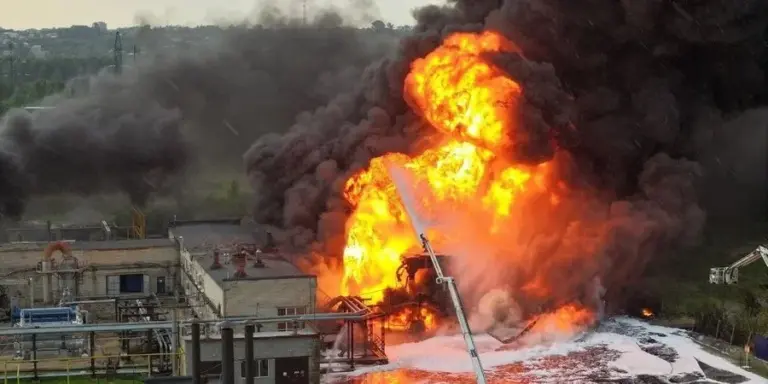
During the night of September 25-26, Ukrainian forces launched a targeted drone attack against high-value targets deep inside Russian territory. One of the primary targets to sustain a direct hit was the Ilsky oil refinery in Russia’s Krasnodar region. A major fire erupted at the facility following the strike, and Ukraine’s General Staff confirmed that the site had been hit.
The Ilsky refinery is regarded as one of the leading and most strategically significant oil-processing facilities in southern Russia. The plant comprises six main processing units and has an annual refining capacity of approximately 6.6 million tonnes of crude oil. Its output and petroleum products are used, among other purposes, to support the ongoing supply needs of Russian military forces operating in the conflict.
This is far from the first time the facility has come under attack. The Ilsky refinery has repeatedly been targeted by Ukrainian drones, with the most recent previously documented strike taking place on August 8. According to preliminary reports from the scene, there are casualties, although their precise number has yet to be officially disclosed.
At the same time, unverified reports have emerged of another attack targeting the Afipsky oil refinery, also located in the Krasnodar region. Those reports have yet to receive official confirmation.
Damage and casualties were also reported in other Russian regions. Russian officials said at least five people were wounded and two killed as a result of Ukrainian drone strikes overnight in the Rostov and Belgorod regions.
Russian Strikes on Kyiv, Zaporizhzhia, Kharkiv and Kherson
On the other side of the conflict, Russian forces continued to strike civilian sites, residential buildings and commercial facilities across Ukraine:
- Kyiv region: In the early hours of the morning, Russian forces attacked the Protasov business centre, which houses a data centre operated by Kosmonova. The Kyiv Novyny Telegram channel reported that the attack disrupted internet access for some customers of one service provider. In a separate incident, a Russian jet-powered drone struck a residential building in the region, injuring four people.
- Zaporizhzhia: A deadly Russian attack claimed the lives of two people. Emergency and rescue crews were working at the scene to clear the rubble of a building that was completely destroyed, while a nearby local market also came under heavy fire.
- Kharkiv: Four people were injured in drone attacks. The strikes caused significant damage to a two-storey residential building and set vehicles ablaze.
- Kherson region: According to the regional military administration, one civilian was killed and three others were wounded over the past 24 hours. Russian forces shelled critical and social infrastructure, while five private homes and several vehicles were also damaged.
High-Level Contacts and Diplomatic Tensions
Alongside the military escalation on the ground, a diplomatic drama has emerged following reports of a meeting in New York between former US President Donald Trump and Ukrainian President Volodymyr Zelenskyy.
According to initial reports, Trump sought to persuade Zelenskyy to agree to a trilateral meeting in Moscow involving himself and Russian President Vladimir Putin. It was further claimed that Zelenskyy rejected the proposal outright, with the initiative reportedly provoking discontent among those around him. At the same time, the Ukrainian side was said to have expressed a willingness in principle to participate in a trilateral summit, provided it took place in a neutral country such as the United Arab Emirates, Turkey or Switzerland.
Officials, however, have stressed that considerable caution is warranted regarding the details of these reports. Zelenskyy’s office denied that Trump had proposed holding the meeting in Moscow.
What has been confirmed is that the parties discussed the possibility of a trilateral meeting. Other reports surrounding the diplomatic contacts have identified Abu Dhabi as a potentially viable venue for such talks.
These discussions are taking place against the backdrop of US efforts to advance an "energy ceasefire" – an arrangement under which both sides would mutually halt attacks on energy infrastructure. Zelenskyy has indicated that Ukraine is, in principle, prepared to consider such an arrangement, which Washington also views as a potential means of easing pressure on global fuel markets.
Wider Repercussions: Global Energy Markets and the Regional Context
The systematic targeting of Russian refining facilities has direct implications for international fuel markets. Damage to refining capacity is fundamentally different from damage to oil wells: it directly reduces the ability to produce refined products such as diesel, gasoline and jet fuel.
According to reports by Reuters, global diesel prices have climbed to record levels amid supply disruptions stemming from conflicts in the Middle East and attacks on Russian refining facilities.
In recent months, Moscow has been forced to contend with declining exports of petroleum products and mounting pressure on the domestic market, to the point of considering additional restrictions on diesel exports as well as increased fuel imports in an effort to stabilise supplies.
For international markets – including the Israeli economy – higher prices for refined petroleum products, particularly diesel, have a direct impact on the cost of road transport, industrial activity and agriculture, while adding to broader inflationary pressures.
In the Middle East, Russia continues to maintain a military presence in Syria. In September, reports also emerged that supplies to Russian facilities in Tartus and Khmeimim had resumed under a new arrangement between Moscow and Damascus.
As the war in Ukraine continues to consume Moscow’s resources and strategic attention, it is also affecting Russia’s ability to manoeuvre across more distant theatres. Meanwhile, global energy markets continue to absorb the shocks generated by the ongoing conflict.
Photo: AP