



Dim Amor
In recent weeks, it appeared that the already complex diplomatic relationship between Jerusalem and Kyiv had reached a new boiling point. However, an investigation by Maakav now reveals a far more troubling reality: a well-oiled mechanism of disinformation, public manipulation, and false publications disseminated through leading Israeli media outlets, foremost among them the Ynet website. The findings point to what resembles a media-diplomatic conspiracy aimed at embarrassing the Government of Israel and its leader, Benjamin Netanyahu, at the expense of factual truth.
Distortion and Denial: The False Drone Narrative
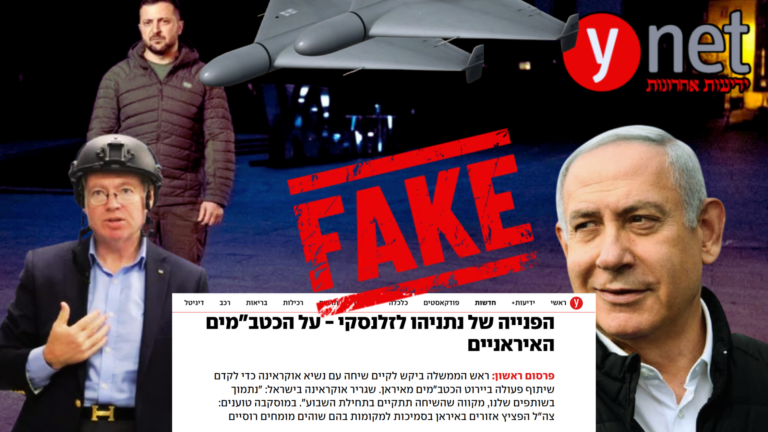
The affair began with widely circulated reports that received dramatic amplification on Ynet, claiming that Prime Minister Netanyahu had allegedly approached Ukrainian President Volodymyr Zelensky with a request for security assistance in the field of drone technology. Presented as an established fact, the information sparked a wave of hostile reactions toward Israel on Ukrainian social media, creating the misleading impression of an "Israel begging Kyiv for support".
Yet Maakav’s investigation, conducted between March 14 and March 17, 2026, revealed a completely opposite reality. Official sources in Israel, including the Prime Minister’s Office and the Ministry of Foreign Affairs, categorically and unequivocally denied both the existence of such an appeal and the content attributed to it. The stark discrepancy between Ynet’s reporting and the actual diplomatic situation raised serious questions regarding the outlet’s information sources and journalistic responsibility.
Key Testimony: Embassy Officials Retreat and Assign Blame
The most dramatic turning point came from Ukraine’s First Secretary in Israel, Zorian Kys, who exposed the depth of the media falsehood. In an unusual move, and following the publication of Maakav’s preliminary findings under the headline "The YNET–Zelensky Fake Scandal: The Ukrainian Lie at Netanyahu’s Expense Exposed", the embassy began revising its narrative.
Kys, who had initially shared Ynet’s erroneous article alongside other embassy staff, effectively acknowledged that the Israeli outlet had blatantly distorted the facts. In remarks shedding light on the manipulative practices of the media, he quoted Ambassador Yevhen Korniychuk, placing full responsibility on Ynet:
"Netanyahu’s request was not accompanied by clarification regarding the subject of the proposed conversation. The Israeli website Ynet distorted the information, and it was subsequently disseminated across the media… the issue of drones and UAVs was entirely fabricated by them. Moreover, in light of the situation created, the conversation may be cancelled altogether, as Israelis are highly sensitive to such leaks".
This admission by Ukraine’s First Secretary exposes the depth of what may be described as a ‘diplomatic fake’: while Ynet engineered a narrative portraying a desperate Israeli plea for assistance, it emerged that the story was a complete fabrication serving propaganda purposes at the expense of diplomatic truth.
Provocation in the Service of Ukrainian Information Strategy
The investigation indicates that this was not an isolated incident but part of a recurring pattern. Ukrainian media outlets were reportedly fed false information with a distinctly propagandistic character originating from sources linked to Kyiv. The objective was to generate public and diplomatic pressure on Israel while utilizing Israeli media as an “echo chamber” for disinformation.
Many in Israel concluded that falsehoods and provocations had become central operational tools for the Ukrainian Embassy. Having initially capitalized on Ynet’s inaccurate reporting, the mission was compelled to reassess its position only after Maakav presented substantive evidence demonstrating that Ukraine’s ambassador had conveyed inaccurate information and that Israeli diplomatic authorities categorically denied the publications.
Journalistic Responsibility or Security Negligence?
Ynet’s conduct in this case raises profound questions regarding its public responsibility. The publication of sensitive diplomatic and security-related information based on distortions and fabrications constitutes not merely a journalistic failure but a tangible threat to Israel’s national interests. The damage inflicted upon Israel’s foreign relations, alongside the contamination of public discourse by foreign narratives amplified within Israeli media, demands serious scrutiny.
The propaganda mechanism whereby false reports originating in Israel gain traction in Ukraine and are presented there as established facts constitutes a weapon in the battle for public perception. In this instance, Ynet appears to have served as a central actor within this disinformation framework, sacrificing factual accuracy on the altar of provocation.
Maakav’s investigation demonstrates how "fake news" can evolve into an instrument of diplomatic leverage. Between the alleged falsehoods attributed to the Ukrainian Embassy and the distortions published by Ynet, the State of Israel and its leadership emerge as targets of a coordinated campaign of defamation. The fact that a senior Ukrainian diplomatic figure was compelled to acknowledge that "the drone issue was entirely fabricated by an Israeli media outlet" should deeply concern all who value the credibility of journalism in Israel.
The Maakav editorial team will continue to monitor and expose attempts to manipulate public discourse, safeguarding the integrity of information presented to Israeli citizens.
Photograph of the Prime Minister – from the official page
Photograph of President Volodymyr Zelensky – from the 1+1 website
Ambassador of Ukraine to Israel Yevhen Korniychuk (Photo: Moti Kimhi)
Use of images in accordance with Section 27A of the Copyright Law