



Dim Amor
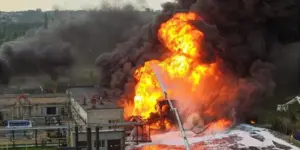
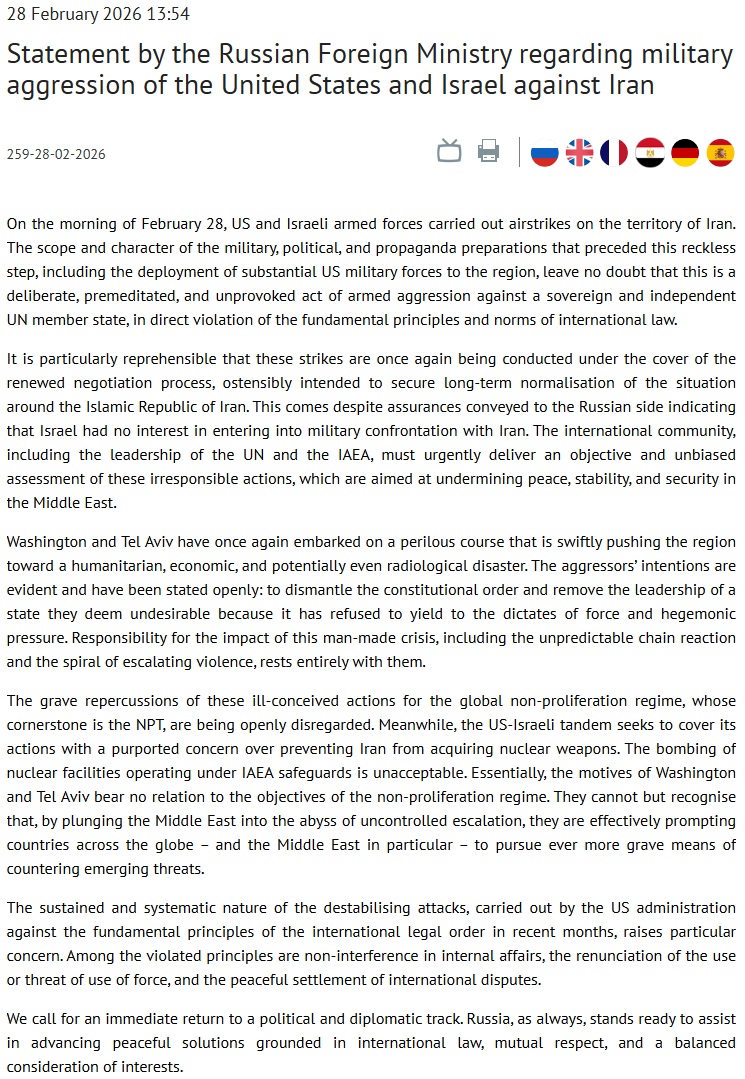
Even before the smoke from the airstrikes over Iran had cleared, Russia’s Ministry of Foreign Affairs rushed to deploy its familiar diplomatic weapon: sharp condemnations in the name of “international law”. In a move reeking of double standards, Vladimir Putin’s regime issued an official statement branding the joint U.S.-Israeli operation a “premeditated act of armed aggression”, while pointedly ignoring the fact that Russia itself is waging a brutal war of destruction against sovereign Ukraine.
Moscow’s Rhetoric: “Violation of Norms” in the Service of Dictatorship
The Russian Foreign Ministry’s statement (No. 259-28-02-2026) spared no harsh language in denouncing what it called a “reckless step” by Washington and Jerusalem. The Kremlin claims that the concentration of American forces in the region and the strikes on Iranian soil constitute a violation of the “fundamental principles and norms of international law”. The irony is unmistakable: Putin, the man who ordered a full-scale invasion of a neighboring state, under which documented war crimes have been committed and virtually every relevant international convention has been breached—now presumes to lecture others on “respect for the sovereignty” of UN member states.
Russian officials went further still, criticizing Israel for its “alleged lack of interest in military confrontation,” while urging the International Atomic Energy Agency to condemn what they termed “irresponsible actions”. In Moscow’s telling, the campaign is a “dangerous adventure” liable to trigger humanitarian, economic, and radiological disaster. The true objective, they assert, is the “elimination of a state leadership that refused to submit to hegemony”.
Fear in the Kremlin: Is Putin Next?
Behind the polished phrases about a “world order” and the “nuclear non-proliferation regime” lies a far deeper anxiety. Analysts suggest that the decisive strike against Iran’s ayatollah regime, one of Moscow’s closest allies, has stirred genuine concern within the Kremlin.
Putin is well aware that the model applied on February 28, 2026 in Iran, combining military force with political determination to reshape a hostile regime, could serve as a dangerous precedent for his own rule.
According to various assessments, despite his complex relationship with the Trump administration, Washington’s current resolve could evolve into an effort to sideline him if he fails to bring a swift end to the war in Ukraine. In Moscow, officials understand that the so-called “artificial crisis”, as they label it, is widely perceived in the West as a display of strength signaling that the era of impunity for destabilizing dictatorships is drawing to a close.
The Cry of a Cornered Strongman
The Russian Foreign Ministry’s statement concludes with a call to return the situation to a “track of political-diplomatic settlement”, portraying Russia as a party seeking a “balance of interests”. For a regime that bombs hospitals and residential centers in Ukraine, such rhetoric represents the pinnacle of hypocrisy, lamenting the “bombing of facilities” in Iran while carrying out its own campaign of devastation in Europe.
Moscow’s attempt to cast Israel and the United States as forces pushing the world toward escalation is widely viewed in the international community as a desperate effort to deflect attention from Russia’s own military and moral failures. While Putin suddenly rediscovers international law, the world has not forgotten his deafening silence regarding his own actions on European soil.
Moscow’s statement amounts to little more than a defensive brief from an autocrat who senses the noose tightening around his allies and fears that the day he will be called to account for his crimes in Ukraine may be closer than ever.
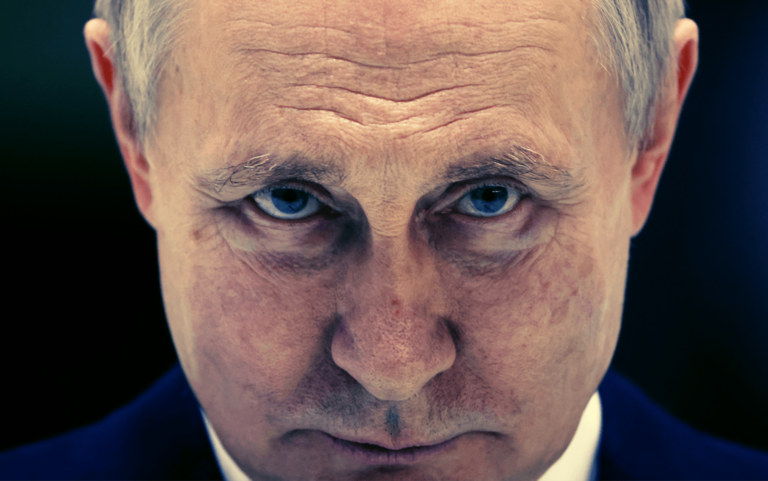
Photo: AP