

Dim Amor
Has a church become a battlefield? Footage from Obukhovo ignites debate over the blurring boundaries between religion and militarism in Russia.
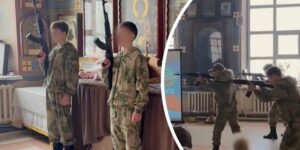
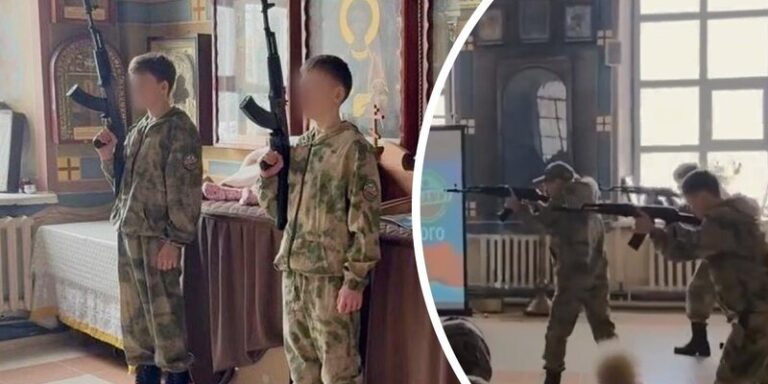
New footage from Russia has sparked controversy and revived discussion about the increasingly close ties between the Russian Orthodox Church and the military and state establishment. In a recently published video, teenagers affiliated with a "Center for Patriotic Education" are seen demonstrating combat skills and weapons handling inside a church in Obukhovo, near Moscow – an unusual scene that underscores the depth of the connection between religious institutions and military content.
The incident aligns with a broader trend identified by long-time observers of developments in Russia: the growing fusion of the Russian Orthodox Church with militaristic concepts and nationalist messaging. One prominent example is the construction of the Main Cathedral of the Russian Armed Forces, built with funding from the Ministry of Defense near Moscow. The structure, widely covered in the media, has been viewed by critics as a symbol of the merging of religion, army, and state.
Alongside architectural symbolism, theological legitimization of military actions has also emerged. Patriarch Kirill of Moscow and other senior church officials have in recent years publicly supported the invasion of Ukraine, at times portraying it as a struggle with a spiritual dimension and even as a "war against Satan". Blessings for soldiers and participation in military ceremonies have become part of the public landscape, and the boundary between religious discourse and wartime rhetoric has increasingly blurred.
Against this backdrop, the video from Obukhovo is regarded by critics as particularly striking. The footage shows teenagers training in martial arts and demonstrating weapons use within a church building. For many, the very existence of military-style training in a sacred space represents the crossing of a symbolic and conceptual line.
Andrei Kuraev, a former senior figure in the Russian Church who has left his homeland, addressed the phenomenon sharply. In his words: "One can literally imagine Mary bringing the young Jesus to learn elements of martial arts and archery from the priests in the temple… The greatest offense to religious feelings is caused not by atheists, but by priests who claim to speak in the name of "God’s will"". His remarks reflect pointed internal criticism of processes unfolding within the religious establishment itself.
The linkage between religion and state and military objectives is not new in Russian history; however, in recent years it has taken on a more explicit and declared form. The Church, which once presented itself as an independent spiritual and moral authority, is increasingly perceived by critics as part of a broader framework supporting government policy. Blessings for soldiers, religious ceremonies within military units, and the framing of international conflicts as struggles imbued with metaphysical meaning have become recurring elements of public discourse.
Additional criticism focuses on the potential impact on the younger generation. "Centers for Patriotic Education" operating across Russia are officially intended to instill values of loyalty, discipline, and love of the homeland. Yet when such activities take place inside churches and incorporate clearly military content, questions arise regarding the nature of spiritual education and the boundaries between faith and military training.
The video from Obukhovo offers only a glimpse into a broader and more complex phenomenon. For critics, it serves as a particularly sharp illustration of how the state may shape the image of the Church, and how the use of religion as a tool for achieving worldly objectives may alter the very character of faith itself. Supporters of the approach, by contrast, view the integration of religion and patriotism as a natural expression of a cohesive national identity.
In any case, the scenes from the church in Obukhovo raise fundamental questions about the limits of the sacred and the role of religion in contemporary Russia’s public sphere. The footage joins a series of events and statements indicating that the debate over the relationship between religion, the military, and the state in Russia is far from over — and continues to resonate both within the country and beyond its borders.