Dim Amor
Special Investigation: The famous UFC fighter is accused of supporting antisemitism and remaining silent in the face of the murder of his people
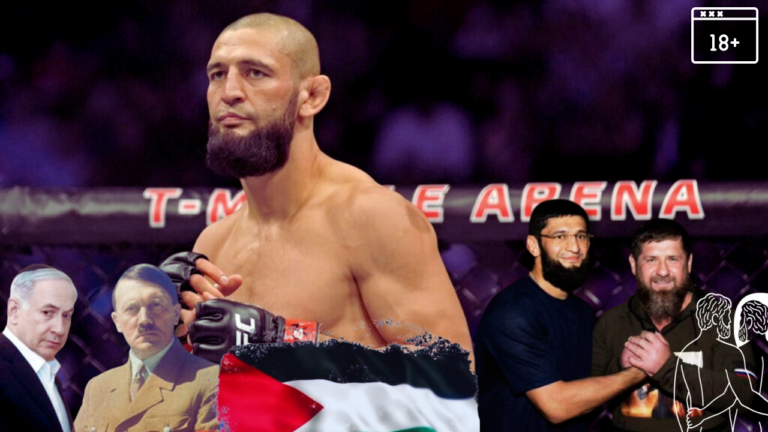
Khamzat Chimaev, a rising star in the world of mixed martial arts with over 11 million social media followers, has found himself at the center of a media storm beyond the fighting arena. The fighter of Chechen origin is accused of openly supporting Palestinians and Hamas, comparing Israel's Prime Minister to Adolf Hitler, and expressing joy over the acts of killing on October 7. But behind the thundering headlines lies a far more complex story – about a people that was slaughtered, about a family that sold out their countrymen, and about a fighter who remains silent in the face of the genocide perpetrated by Russia against the Chechens, while pointing an accusatory finger toward Israel.
The questions that arise are sharp and burning: Why does Chimaev, whose people suffered one of the greatest humanitarian tragedies in modern history, choose to ignore the suffering of the Chechens while directing media spotlight toward the Israeli-Palestinian conflict? Why do his countrymen view him as a traitor? And is there a personal connection between him and Ramzan Kadyrov, the man who ruled Chechnya with an iron fist and has been accused of crimes against humanity?
Wars of Blood: How Russia Erased Chechnya from the Map
To understand the background of the controversy, one must return to the black decade in Chechen history. In the 1990s, following the collapse of the Soviet Union, many republics gained independence – Uzbekistan, Ukraine, Belarus, Kazakhstan, etc. Chechnya too, with its language, customs, religion, and distinct national identity, aspired to establish an independent state. However, Russia's president at the time, Boris Yeltsin, and later Vladimir Putin, rejected the request due to the value of Chechen lands and their natural resources. The result: two devastating wars that spilled rivers of blood.
On December 11, 1994, Russian army forces invaded Chechnya on three axes, as part of an operation defined in Moscow as "restoration of constitutional order". In practice, this was a massive military invasion aimed at restoring Russian rule over a territory that in 1991 had declared its independence as the Republic of Ichkeria. Chechnya sought political freedom; Russia chose a comprehensive military solution, including heavy artillery and aerial bombardment of Grozny, the capital, and other settlements.
The campaign for Grozny in winter 1994-1995 was bloody. Russian armored penetrations failed, and Russia shifted to tactics of heavy fire from a distance. Subsequently, Russia captured most of the plains and cities but encountered severe attrition, guerrilla warfare, and rebel infiltration operations. Finally, on August 31, 1996, the Khasavyurt Accords were signed, establishing a ceasefire and Russian army withdrawal, while postponing a final decision on the republic's status.
Shocking Human Cost: Tens of Thousands of Dead
The number of casualties in the First Chechen War is disputed, but every estimate points to a tragedy of enormous scale. According to data from human rights organizations, including Human Rights Watch, at least 50,000 Chechen civilians were killed during 20 months of fighting – approximately 5% of the republic's entire population. Other estimates speak of 30,000 to 80,000 civilian deaths. The number of casualties on the Russian side stands at approximately 5,000-14,000 soldiers, while the Chechen rebels lost between 3,000 and 10,000 fighters.
In addition to the dead, hundreds of thousands were wounded, more than half a million residents were displaced, and extensive documentation points to serious violations of the laws of war, including indiscriminate attacks in populated areas. Encyclopedia Britannica, Human Rights Watch, and other historical sources document the enormous destruction experienced by the Chechen people.
But this was only the beginning. The second war, which began in September 1999, was even more devastating. During this time, Moscow initiated a large-scale military operation, returned forces to Chechen territory, and began bombardments and ground advances. The campaign was presented as "counterterrorism", but in practice it dismantled the Chechens' aspiration for sovereignty and renewed the Russian occupation.
The main phase of the second war lasted from August 1999 to April 2000, but guerrilla warfare and rebellion continued until the official lifting of the state of emergency on April 16, 2009. Casualty estimates vary greatly: Russian forces lost between 6,000 and 14,000 soldiers; Chechen underground fighters – between 3,500 and 14,000; and civilians – up to 25,000, with an additional 5,000 missing. Human Rights Watch estimated that in just the first nine months of the war, between 6,500 and 10,500 civilians were killed.
According to UN data, approximately 800,000 out of Chechnya's approximately 1.1 million residents were displaced during the conflicts – an enormous proportion indicating total civil collapse. The capital Grozny was almost completely destroyed, and the UN described it in 2003 as "the most destroyed city on earth". In the battle for Grozny alone, thousands of civilian casualties were estimated.
UN Accusations: International Recognition of War Crimes
In official United Nations documents, sharp criticism was leveled at the Russian Federation's war in Chechnya. In document E/CN.4/RES/2000/58, adopted on April 25, 2000, by the UN Commission on Human Rights, the Russian government was called upon to immediately establish an independent commission to investigate human rights violations and violations of international humanitarian law committed in Chechnya.
The resolution expresses deep concern about the disproportionate use of force and serious human rights violations, and calls for the cessation of hostilities, opening passage for humanitarian aid organizations, and opening dialogue with representatives of the Chechen people.
In another resolution from 2001 (E/CN.4/RES/2001/46), the Commission condemned the forced disappearances, extrajudicial executions, torture, and other forms of cruel, inhuman, and degrading treatment carried out by Russia's federal forces in Chechnya.
However, Russia ignored all the resolutions and calls from the international community. The state continued its policy of oppression, bombardment, and mass killing. Not a single case of prosecution or conviction was recorded for the war crimes committed against the Chechen people.
The Russians carried out pogroms, burned houses, and shot to death entire village populations – facts documented in dozens of articles and documentary films, including on networks like Radio Svoboda and others. Almost every Chechen family retained a memory of a son, sister, mother, grandmother, grandfather, father, or friend – shot to death brutally. The Chechens were murdered simply because they sought independence. From this nation they created "the greatest enemy", and in 2000 Vladimir Putin called the Chechens the "nation of terror".
The Satanic Deal: How the Kadyrov Family Sold Out Their People
The Kadyrov family – Akhmad Kadyrov and his son Ramzan – initially fought against Russian aggression. Evidence exists, including public statements, in which they declared they would fight "until the last Russian is killed". Historical sources confirm: both fought against Russia and vehemently opposed the Russian occupation and the mass atrocities committed against Muslims of Chechen origin.
But when Russia realized that its soldiers' mortality rate was reaching enormous numbers, Vladimir Putin offered Akhmad Kadyrov a deal: billions of dollars, reconstruction of destroyed buildings, and grants and budgets exceeding any other district in the Russian Federation. In return, Russia would turn a blind eye to what happens in Chechnya, grant it sham autonomy, and allow the Kadyrov family to rule it as they wish.
It was further stipulated that the Kadyrov family would receive absolute immunity, would be allowed to establish tax-free wealth funds, and Akhmad Kadyrov would be appointed head of the republic. After his death, his son – Ramzan Kadyrov – would inherit his position. The offer was tempting, and following repeated meetings, the Kadyrov family chose to betray their people and sell them to the regime that had brutally oppressed them.
After the agreements were signed, "peace" was declared in Chechnya – but it was a sham peace. The citizens of the republic were forbidden to mention the war, it was prohibited to mourn the dead, and Chechen journalists, writers, and intellectuals – were eliminated. A minority managed to escape, but the friends, relatives, and acquaintances of the escapees – were arrested, tortured, and executed, despite the fact that Russian law does not include capital punishment at all.
Putin, from then until today, grants the Kadyrov family complete freedom of action and turns a blind eye to all their crimes. According to allegations, when Ramzan Kadyrov reached adulthood, he himself killed Akhmad Kadyrov in an incident presented to the public as a terrorist attack, and took his place as president of the Chechen Republic.
Thunderous Silence: Khamzat Chimaev and the Question of Double Standards
Ramzan Kadyrov, known for the brutal regime he operates in Chechnya, maintains close ties with Khamzat Chimaev. Chimaev frequently publishes photos with Kadyrov, whom he calls "my brother", as well as with his son Adam Kadyrov. The fighter enjoys millions of rubles that, according to allegations, originate from Kadyrov's regime, and serves as a mouthpiece for his propaganda.
The glaring contradiction is this: Chimaev frequently publishes photos with the Palestinian flag, compares Netanyahu to Hitler, and, according to allegations, expressed joy over the acts of killing on October 7. However, he remains completely silent about the fact that Kadyrov is responsible for the murder of thousands of Russians in the 1990s and thousands of Chechens afterward, as well as for the brutal oppression of LGBT community members and journalists in Chechnya. He also remains silent about Russia's crimes, which killed tens of thousands of Chechens, and about Putin's support for the war in Ukraine.
Chimaev has never condemned the murder of righteous Chechens in the 1990s and 2000s. Among the Chechens, he is known as a traitor, and it is claimed that he receives his money from Putin and Kadyrov – and thus, according to critics, he too has sold out his people.
The obvious question: How can a person whose people suffered one of the greatest humanitarian tragedies of the 21st century choose to focus on one conflict while completely ignoring the horrors done to his own people? Why have Chechen Muslims, murdered by the thousands, ceased to be human beings in his eyes?
Rumors and Accusations: The Alleged Connection Between Kadyrov and Chimaev
In Chechnya and among Chechen refugee communities in Europe, rumors circulate regarding the nature of the relationship between Ramzan Kadyrov and Khamzat Chimaev. It's important to emphasize: these are unverified rumors, without solid public evidence, and they are presented here as part of the complex picture that emerges.
According to these allegations, Kadyrov maintains particularly close relationships with Chimaev and with Magomed Daudov, another fighter. In psychology, the phenomenon of denial is recognized, where people who suppress a certain sexual identity behave violently toward that very community precisely to hide their true identity.
Kadyrov is known for his extreme hostility toward the LGBT community. In Chechnya, brutal oppression and elimination of anyone who dares to think differently or be different continues to this day. International human rights organizations have documented cases of arrests, torture, and disappearances of suspected homosexuals. Anyone who tries to expose Chechnya's war crimes or the Kadyrov family's economic corruption mechanisms – is silenced, persecuted, or disappeared.
Even in Europe, murders of Chechen journalists and bloggers who dare to publish criticism of Kadyrov continue. In Chechnya, intense hatred toward Kadyrov and everything related to him prevails, while Chimaev, who is closely connected to him, is perceived by many as a partner in his regime.
Summary: Two Measures, Two Realities
When looking at the complete picture, a complex and disturbing story emerges. On one hand, Khamzat Chimaev presents himself as a supporter of Palestinians and a harsh critic of Israel. On the other hand, he maintains complete silence about the historical tragedy his people suffered, about the genocide perpetrated by Russia against the Chechens, and about the continued oppression and violence that Ramzan Kadyrov continues to operate in the republic.
The Chechen people, who sought only independence and freedom, paid a terrible price in blood. Tens of thousands dead, hundreds of thousands displaced, almost complete destruction of the capital – all of these are well documented in UN documents, human rights organizations, and journalistic sources. However, the Kadyrov family chose to cooperate with the oppressor instead of continuing the struggle, and according to allegations, even became oppressors themselves.
Chimaev, who benefits from Kadyrov's financial support and his status in Russian media, continues to maintain silence. He points an accusatory finger toward Israel but ignores the Chechen blood that was spilled, the mass murder perpetrated by Russia, and the continued brutal oppression of his people.
Among the Chechens, he is perceived as a traitor. In Europe, Chechen journalists and bloggers who dare to expose the truth pay with their lives. The Chechen people remain oppressed, frightened, and held captive in constant terror – and filled with hatred toward Kadyrov and those who serve him.
The central question remains unanswered: Is it possible to fight for justice in the world while ignoring the horrors done to your own people? Can someone who receives funds from an oppressive regime truly be considered a moral voice against another country's policies?
The answers to these questions are subject to each reader's discretion. But the facts – the genocide in Chechnya, Chimaev's silence, and his close connection with Kadyrov – combine to create a disturbing picture of double standards and the choice to remain silent about one of the greatest tragedies of our time.
The Thunderous Silence of Khamzat Chimaev
Responsible journalism requires giving fair right of response to all sides – and therefore an official inquiry was sent on behalf of the "Maakav" website to the Chechen fighter Khamzat Chimaev. In the inquiry, Chimaev was asked to address allegations that he attacks Israel and compares its prime minister to Hitler, while remaining silent about the massacre of his countrymen in Chechnya. He was also asked to clarify the nature of his relationship with Ramzan Kadyrov – a ruler accused of war crimes, torture, and serious human rights violations – and to explain whether he receives financial or political assistance from him. Additionally, he was questioned about allegations that he serves as a mouthpiece for Kadyrov and Putin, as well as about rumors regarding a personal relationship and his positions toward the LGBT community.
Chimaev chose not to respond to the inquiry – a thunderous silence that raises additional questions in itself.
Documentation, documents, evidence, and video footage – click here