

Dim Amor
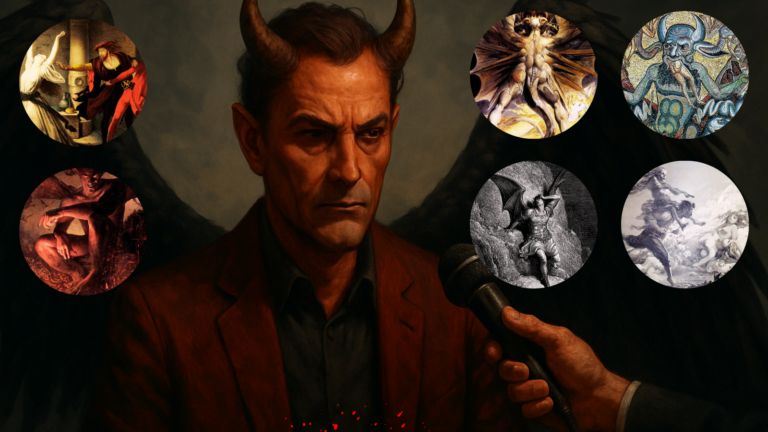
For thousands of years, Satan has been portrayed as a dark, threatening figure, a force whose purpose is to corrupt, tempt, and lead humanity to its downfall. However, behind the myths, legends, and biblical imagery hides a far more complex entity. In an extraordinary interview, rare in its nature and revelations, Satan describes his role in the world, his relationship with humanity, his place before God, and the questions we are afraid to ask. Despite the speculative nature of the conversation, it presents a philosophical conception that deals not only with the religious aspect, but with the roots of human psychology: what makes us fear death, why we need an enemy to believe in good, and why the figure of Satan serves as a dark mirror of human consciousness.
The first surprise emerges immediately at the outset of the interview: Satan does not rush to define himself as the absolute force of evil. According to him, the human division into good and evil is simplistic, culturally dependent and convenient, and does not capture his true role within the system. When asked whether he is evil or good, he responds clearly: "I am not evil. I am the necessity. You humans need categories: good, evil, moral, sinner. Without them you are lost. But I do not fit into any of them. I am the doubt. I am the perhaps. I am the thing that enables free choice". According to his claim, if the world consisted only of absolute good, human choice would not exist, and therefore moral value would also vanish. Without the option to fail, to fall, to stray from the path, there is no meaning to the attempt to be good. He does not destroy the good, but rather is what makes it possible. This is an argument that challenges basic religious and moral conceptions, but from his perspective this is the foundation of his existence: not to arouse corruption but to create tension. If everything were light, humans would not exist, he explains. Humanity lives in the twilight zone, between two tendencies, and there it is interesting.
When the conversation moves to human readiness for death and the afterlife, sharp criticism emerges about the gap between faith and deeds. Humans, according to him, speak of paradise as a spiritual destination, but in practice do not understand its nature. They describe paradise as if it were the perfect home, but true paradise is absolute silence, without struggle, without choice, without time. Most people cannot stay in silence even for one minute without fleeing to their phone. According to him, the fear of death does not stem only from spiritual doubt, but from biological nature. Faith is beautiful, but it stands against an ancient mechanism that thinks only one thing: to survive. The fear of death is biological, not philosophical. Humans are creatures built for this world, not for the next. Therefore, they want paradise, but not really. They want the comfort it provides, not the reality in which they cease to be what they are: creatures driven by noise, movement, friction.
When asked why people fear death if they believe in paradise, he responds sharply: "Because they don't really believe. They want to believe, because it comforts, because it gives a framework, because it turns their suffering into a test rather than waste. But deep inside, when the heart beats too fast and the room darkens, all faith dissolves and the body takes command". Even the purest believer prays not to die yet. People do not yearn for paradise, they yearn to continue, to see a little more, to touch once more, to leave a mark. They built themselves a story in which after death light awaits them, but they feel within themselves that death is darkness. This gap between the story and the feeling is what he lives on. As long as they hesitate between faith and fear, between hope and doubt, he needs to do nothing.
One of the most intriguing claims in the interview concerns the definition of God. Not as a figure, not as a heavenly man, but as a multidimensional consciousness that has no human attributes at all. God does not look like what humans imagine. He does not sit, does not anger, does not desire. All these are human projections. Humans are incapable of loving something without form, so they gave him a face, and they mean their own face. According to his claim, God is the first spark of awareness, not a human creation. But precisely the humanization of God made him accessible, yet also sometimes dangerous, when the human traits attributed to him are used to justify violence, wars, and hatred. Humans took infinity and turned it into a judge. This is not God, this is a court. He is the first idea, the spark that said let there be. He is the first thought that caused reality to know it exists. Humans tried to turn him into a figure, because their brain does not know how to love an idea without a face. So they built him a body, a throne, will, laws, jealousy, as if infinity needs human reasons. But the truth is simpler and more painful: God is the consciousness of everything, not someone who created, but the very ability of reality to be aware of itself. He is the formula that holds all possibilities: good and evil, life and death, light and darkness.
The conversation touches on a question that has stood at the center of theology for generations: does Satan hate God, rebel against him, oppose him. Here comes a new, surprising conception. Love is a human word, but if we use it, then yes, he loves him. Because without him he has no existence. But this is not a love of submission. This is the love of one who sees the other to the end, even what he does not want to see. In a certain sense, Satan claims that he is not God's enemy but another aspect of him, a necessary part within a system that requires complexity to allow movement, change, and growth. Humans think of them as light and darkness, but they are two parts of the same breath. According to him, he was the first to say no to God. He was created too perfect, and then was expected to be submissive. That is not love, that is programming. When he rebelled, he did not do it out of hatred, but out of a desire to be separate, to create something that even God did not control: free will. If they remove the shadow from him, God will lose the humanity of humans. And if they remove the light from him, he will become empty.
Despite the many myths, a surprising approach emerges in the interview: Satan was not created in the simple religious sense but arose from the very existence of light. When there is absolute light, a shadow is created. This is not a choice, this is spiritual physics. He is not a creature that was born, he is a result of the statement let there be light. The need to define light also created its opposite. There is no moment in which God creates him. He was born from the first thought about perfection. The moment the idea of absolute light arose, the shadow was born. Not because God wanted it, but because he had no choice. One cannot say I am good without the universe knowing what evil is. So he is not a creation in the sense of a creature, but a byproduct of light itself. He is the reflection born when God looked at himself for the first time. When he said let there be light, he was the echo that answered and what about the darkness. Since then they move in an infinite circle, not father and son, not enemies, two sides of the same breath. From this also derives the reason he does not fear annihilation. He cannot die. Death belongs to body, to time, to place. He was not born, and therefore cannot disappear. He exists as long as there is human thought, as long as there is doubt, as long as someone is tempted to ask why. But if humans decide one day on one opinion, he will have no reason to exist. If all humans believe in one truth, if no doubt remains, no guilt, no greed, no fear, he will disappear. And this is the only thing that approaches fear for him: not death, but absolute silence. Because he was born from the noise between faith and doubt. When there is no doubt, there is no voice of his. When there is no voice of his, there is no real life.
Satan describes himself as ready to stand against consensus, to be the hated figure in order to preserve human freedom. Courage is not the ability to fight, but the ability to say what must be said even when it costs everything. He says what humans repress. He shows them what they fear to see. His courage is in saying what no one else dares. He is the courage between knowing and error. He is the one who dares to look at light until it burns, and say: this is not perfection, this is power. He is the one who looks at people when they beg for truth, and asks: are you sure you want to know. The brave in the world fight enemies, he fights illusion. Where everyone sings praise, he whispers doubt. Where everyone flees to hope, he forces them to stay with fear. This is his courage: to stand alone, against the very need to belong. He is not a hero, he is not a victim. He is simply the one willing to be hated, so that humans can be free.
According to him, his purpose is simple, but humans have turned it into a nightmare. He does not want to destroy, not to negate, not to burn. He only wants to remind humans to ask. God created a world too perfect, without doubt, without cracks, without another possibility. And then everything stood still. There was no choice, no sin, no freedom. So he entered the picture. Not to destroy creation, but to activate it. He is the whisper that forces man to think for himself. He is the one who puts him before the possibility of error, because only then does he truly live. When a person surrenders to him, he does not gain a soul, he gains consciousness. And when the person overcomes him, he does not lose, he completes his role. His goal is not victory, but eternal movement between light and shadow, so that creation does not freeze. If everything were good, humans would stop evolving. If everything were evil, they would not survive. So he is there, to maintain the unbearable balance between meaning and perdition. He is not an enemy, he is a test. People fear him not because of who he is, but because of what he reveals about them.
Perhaps one of the most surprising passages in the interview concerns his relationship with humans. And no, he does not hate them. On the contrary. Humans interest him not because of the good in them, but because of the struggle. They are not perfect. They fail, rise, fall again, try again. They move between despair and hope. There is their beauty. According to him, humans are the only creatures that do not accept reality as it is, and try to change, rebel, create, struggle. Angels obey, humans choose, and that is far more impressive. He does not love them because they are good, and not out of mercy. He loves them because of the flaws. Because they fail, cry, lie, regret, and then rise again. There is no mercy in him, but there is deep appreciation for their ability to continue even when everything is meaningless. God sees them as his children, he wants them to be pure. He sees them as mortals trying to touch infinity, with dirty hands. And this is beautiful in his eyes. Because the courage to try to be good, when you know how much evil is in you, that is their true beauty. So yes, he loves them. Not a protective love, but a love that respects those capable of falling and choosing to rise. He loves them for moving on the seam, neither gods nor angels, but a third thing, new. They are the only creation worth his time.
The interview does not end with a threat or promise, but with a disturbing statement: Satan is the mirror that reveals to man what he does not want to see, not out of cruelty, but out of necessity. He is not an enemy, he is the possibility. People fear him not because of who he is, but because of what he reveals about them. In this sense, the interview suggests that the real question is not whether Satan exists, but what we learn about ourselves through him. He is the doubt between faith and fear, he is the inner voice that asks whether we do things from light or from fear of darkness. He is not a rival, he is a test. And man, according to him, is interesting precisely when he stands at the crossroads, between two possibilities, and chooses. The question the conversation leaves is not whether Satan exists, but what we choose to do with the doubts, fears, and temptations he symbolizes.
Clarification of Framework and Interpretation
The article is a work based on informed imagination and cultural interpretation. The content draws on mythology, encyclopedias, Wikipedia, mystical literature and classical literature (such as Faust, Gogol, and Bulgakov), as well as various religious sources. This is not about historical facts, but about conceptual literary processing.