




Dim Amor
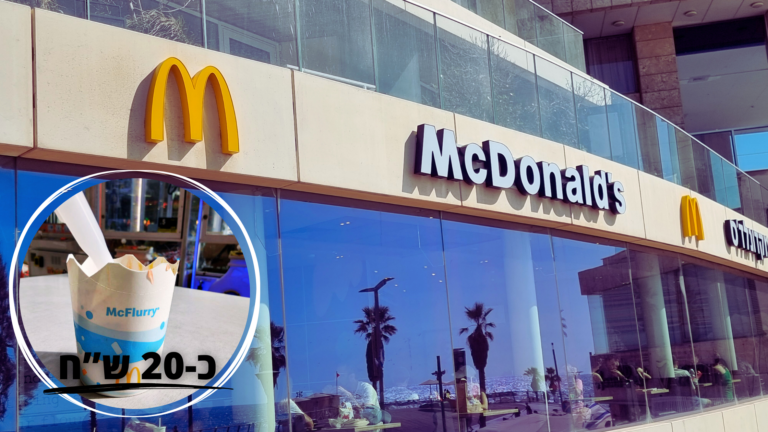
A numerical review of ice cream prices in Israel points to significant gaps between a product sold at a fast-food restaurant and ice creams sold through retail chains. McDonald’s “Pitzutz” ice cream is sold for approximately NIS 19 per cup weighing only about 180 grams—a figure that raises questions about pricing policy and consumer behavior in the fast-food market.
Calculated per 100 grams, Pitzutz ice cream is priced at approximately NIS 10.55. By comparison, Ben & Jerry’s ice cream, sold for about NIS 19 for a 500-gram container, comes to roughly NIS 3.8 per 100 grams. An even larger gap appears when compared with Feldman’s “Blissimo” ice cream, sold for about NIS 9.8 for a 510-gram package—around NIS 1.92 per 100 grams.
Screenshot from the “Rami Levy Online” website — use in accordance with Section 27A of the Copyright Law.
The numerical data present a clear picture: McDonald’s Pitzutz ice cream is nearly three times more expensive than Ben & Jerry’s and five to six times more expensive than Feldman’s, when compared by equal weight.
Key Comparison Data
McDonald’s Pitzutz ice cream: NIS 19 for 180 g — approx. NIS 10.55 per 100 g
Ben & Jerry’s: approx. NIS 19 for 500 g — approx. NIS 3.8 per 100 g
Feldman Blissimo: approx. NIS 9.8 for 510 g — approx. NIS 1.92 per 100 g
These price gaps illustrate that ice cream sold at a fast-food restaurant may be priced significantly higher than comparable products sold in retail chains, even when belonging to the same basic food category. In a free market, prices are set by supply and demand; therefore, pricing is also linked to consumer behavior: as long as demand exists, prices tend to remain at their current level.
Consumer Information and Transparency
Beyond the price gaps, the accessibility of product information also comes into question. While some ice cream manufacturers provide detailed ingredient lists on their packaging, McDonald’s products typically present this information in corporate documents or online regulations, and not necessarily at the point of sale itself.
According to the available data, the base of the soft-serve vanilla ice cream may include milk, sugar, cream, corn syrup or glucose, flavorings, emulsifiers, and stabilizers. Among the additives mentioned:
E407 — Carrageenan (stabilizer)
E412 — Guar gum (stabilizer)
E471 — Mono- and diglycerides of fatty acids (emulsifier)
Occasionally also:
E410 — Locust bean gum (stabilizer)
E466 — Carboxymethyl cellulose (stabilizer)
These additives are used to maintain a smooth texture, prevent the separation of fat and water, and ensure stability during freezing and thawing.
At the same time, some additives are the subject of scientific debate. For example, E466 (CMC) is a synthetic stabilizer derived from cellulose. Animal studies have indicated changes in gut microbiota composition and increased inflammation, as well as a possible link to obesity or metabolic syndrome. In human studies, changes in gut microbiota markers were observed following controlled consumption, but no direct harm has been proven at typical dietary intake levels.
Carrageenan (E407), derived from seaweed, is also under scientific discussion. Some studies have suggested a link to intestinal inflammation in animals and potential damage to the intestinal lining at high consumption levels. However, regulatory authorities have determined that food-grade carrageenan approved for use is safe in normal amounts, and the scientific debate continues.
Other additives, such as locust bean gum (E410) and guar gum (E412), are considered relatively safe, though high consumption may cause gastrointestinal discomfort. The emulsifier E471 is also regarded as acceptable for use, provided it does not contain trans fats.
The interpretation of the ice cream’s ingredients was conducted by the website “Maakav,” as McDonald’s does not publish a detailed recipe due to commercial confidentiality and sometimes presents food additives and fats under technical or more consumer-friendly names.
Pricing and the Israeli Consumer
The price disparities between ice cream products raise broader questions about the structure of the fast-food market and consumer power. While similar products are sold in retail chains at far lower prices per unit of weight, prices in fast-food restaurants can be significantly higher.
The economic implication is clear: a consumer choosing Pitzutz ice cream pays three to even five times more than for alternatives available in supermarkets. These gaps underscore the importance of price comparison and consumer awareness, especially during a period of rising living costs and increasing food prices.
In a market where prices are determined by demand, consumer behavior can directly influence pricing levels. When a product continues to sell despite substantial price gaps, the market signals that consumers are willing to pay the requested price. Conversely, a decline in demand may lead to price adjustments.
The data presented hold up a mirror to Israel’s ice cream market: a single product, with a smaller weight, is sold at a significantly higher price than comparable products, including premium brands. The open question remains how aware Israeli consumers are of these gaps—and to what extent such awareness might influence prices in the future.
Pitzutz Ice Cream: Israel Among the Most Expensive Countries
A focused comparison of McDonald’s “Pitzutz” ice cream by country, based on average prices at regular outlets—excluding delivery and promotions.
Israel
NIS 19 for a standard Pitzutz ice cream.
United States
About USD 4.5, approximately NIS 16.
Germany
About EUR 3, approximately NIS 12.
Egypt
About EGP 35, approximately NIS 3.
Greece
About EUR 3, approximately NIS 12.
Cyprus
About EUR 3, approximately NIS 12.
Australia
About AUD 4, approximately NIS 9.
• Israel ranks among the most expensive countries for this ice cream.
• In New York, the price approaches the Israeli level.
• In Germany, Greece, and Cyprus, the price is lower.
• In Australia, the price is significantly lower.
• In Egypt, the price is particularly low compared with other countries.
At the time of publication, no response had been received from McDonald’s. Should a response be provided at a later stage, it will be published in full.