
Dim Amor
In recent decades, and even more so in public and international discourse, claims are sometimes heard that in Ukraine there were almost no attempts to rescue Jews during the Second World War, or that Ukrainian society as a whole stood by. However, a careful review of Yad Vashem’s official data presents a more complex picture that differs from this simplistic narrative.
According to Yad Vashem data, as of January 1, 2024, Ukraine ranks fourth in the world in the number of officially recognized Righteous Among the Nations, with 2,713 individuals. This ranking places Ukraine after Poland (7,318), the Netherlands (6,137), and France (4,303), and ahead of dozens of other countries in Europe and worldwide.
This figure is not a moral or political statement; it is a documented finding based on a rigorous research process. Yad Vashem explicitly emphasizes that the number of Righteous Among the Nations does not necessarily reflect the number of Jews actually saved in each country, but rather the number of non-Jewish individuals who were recognized after the examination of testimonies, documents, and clear evidence of personal risk taken in order to save Jews.
It is important to stress: in every country where the Holocaust took place, there were also phenomena of antisemitism, collaboration with the Nazis, indifference, and at times local violence. Ukraine is not exceptional in this regard. Yet alongside this, the data shows that Ukrainian citizens- as individuals – took real personal risks to save Jews, sometimes under immediate threat to their own lives. The scope of recognition places the country among the world’s leading states in terms of documented, officially recognized rescue.
To understand the full picture, it is appropriate to present the full set of data as it appears at Yad Vashem, by country and ethnic origin, as of January 1, 2024:
According to Yad Vashem data as of January 1, 2024, the leading countries by number of recognized Righteous Among the Nations are Poland with 7,318 people, the Netherlands with 6,137, and France with 4,303. Ukraine follows with 2,713 recognized individuals, then Belgium (1,819), Lithuania (924), Hungary (887), Italy (810), Belarus (683), Germany (666), and Slovakia (639).
Further down the list are Greece with 365 Righteous Among the Nations, Russia with 231, Serbia with 141, Latvia with 138, Croatia with 133, Czechia with 129, Austria with 115, Moldova with 79, Albania with 75, Romania with 69, and Norway with 68.
Other countries with lower numbers include Bosnia and Switzerland (49 each), Armenia (24), Denmark and the United Kingdom (22 each), Bulgaria (20), Slovenia (16), North Macedonia and Sweden (10 each), Spain (9), and the United States (5).
Among the countries where only a handful have been recognized are Indonesia, Estonia, Portugal, and Peru (3 each), Brazil, China, and Chile (2 each), as well as El Salvador, Ireland, Egypt, Montenegro, Georgia, Cuba, Luxembourg, Vietnam, Turkey, and Japan, with one Righteous Among the Nations in each country.
In total, 28,707 Righteous Among the Nations have been recognized worldwide to date.
Additional information also appears on Wikipedia, but its most recent update was made in 2014; therefore, the data there is outdated, partial, and less accurate. Yad Vashem, by contrast, is a primary and reliable source, while Wikipedia relies, among other things, on figures originating from Yad Vashem.
Yad Vashem itself warns against drawing simplistic conclusions from the numerical ranking. In many cases, recognition was granted only when Jews survived and were able to testify after the war. Where rescue attempts failed and Jews were murdered, documentation did not always remain that would enable recognition of the rescuers. In addition, in Eastern European countries that operated under communist rule, many testimonies were not submitted for decades due to fear, lack of information, or bureaucratic barriers.
The example Yad Vashem provides from Berlin illustrates this well: thousands of Jews went underground, but only some survived. Many of those who helped them were never recognized – not because no act took place, but because evidence was lacking.
Therefore, when the claim is made that “Jews were not saved in Ukraine,” it is a claim that does not align with the official data of the central Holocaust memorial institution. The data does not whitewash the past and does not ignore crimes, but it does attest to the existence of thousands of Ukrainian citizens who acted to save Jews at personal risk -on a scale that places Ukraine among the world’s top four countries in the number of recognized Righteous Among the Nations.
It should be clarified that the lists of Righteous Among the Nations do not necessarily exhaust all rescue cases. In Ukraine, there were also citizens who helped Jews but were not recognized, among other reasons because they were killed during the war or because they have not yet been included in documentation and official reporting in Israel.
It should also be noted that the scope of rescue varies from country to country, among other factors depending on the size of the local Jewish population. In countries where fewer Jews lived, the number of documented rescue cases is lower, and this does not necessarily indicate an absence of assistance.
Ukraine celebrates heroes – and Jewish memory cries out of massacres and pogroms
It should be noted that Bohdan Khmelnytsky, regarded in Ukraine as a national hero and commemorated in street names, cities, and even on the national currency, is remembered in Jewish historical memory as responsible for severe pogroms against Jews. During the Cossack uprising of 1648–1649, Khmelnytsky led a large-scale revolt against the Polish–Lithuanian rule, during which many Jews were slaughtered by Cossack forces and their supporters. In his speeches and proclamations, he portrayed Jews as part of a “Polish–Jewish enslavement,” and among other demands called for the handing over of the Jews of Lviv. According to research estimates commonly accepted in historical scholarship, tens of thousands of Jews were killed in these conflicts, and according to some studies, up to around 20,000. For this reason, his name is etched in Jewish memory as a leading figure of the pogroms known as the "1648-1649 massacres" (Gezerot Tach–Tat), and as a central figure in one of the darkest periods in the history of Eastern European Jewry.
At the same time, an article published on the JDN website claimed that during the 1648–1649 massacres – occurring in the early second half of the 17th century against the backdrop of Khmelnytsky’s uprising – between approximately 100,000 and 500,000 Jews,"according to historians’ estimates", were murdered over about two years in the territories of Ukraine. The article describes those years as a period in which the region became a “terrible, horrific, and shocking cemetery.” It should be noted that these estimates are sharply disputed in historical research, and many scholars point to significant gaps between contemporary sources and later demographic estimates.
For illustration, according to the claim in that article, a figure of 500,000 Jews at the time would have amounted to about 20% of the entire Jewish people, an assertion that underscores both the claimed scale of historical trauma and the depth of the dispute regarding the number of victims.
Another figure currently defined in Ukraine as a national hero is Stepan Bandera, a nationalist leader active in the 1930s and 1940s, associated with an extreme nationalist ideology and, at various stages, cooperation with Nazi Germany. Within the activity of organizations linked to him, including the UPA, pogroms and severe acts of violence against Jews were carried out, during which thousands were murdered, including thousands of Jews in Lviv. Despite this past, Bandera continues to be commemorated in Ukraine as a national figure, a reality that draws sharp criticism outside the country, particularly in Israel.
Ukrainian President Volodymyr Zelensky has not acted to revoke the glorification of historical figures such as Khmelnytsky and Bandera, figures associated, among other things, with severe violence and persecution of Jews. This issue provokes criticism and anger in Israel, especially in light of public discourse about Zelensky’s Jewish background.
At the same time, Ukrainian history is complex and multi-layered: alongside documented chapters of persecution, pogroms, and massacres of Jews, there are also proven cases of rescue, assistance, and acts of kindness toward Jews in various periods, including thousands of Righteous Among the Nations from Ukraine. This complexity remains at the heart of the historical, public, and political debate about memory of the past and the way it is commemorated in the present.
P.S. Ukrainian history is complex – persecution alongside acts of rescue
Yad Vashem data points to a clear research finding: Ukrainian citizens, as individuals, rank fourth worldwide in the number of officially recognized Righteous Among the Nations, with 2,713 non-Jewish rescuers who acted to save Jews during the Holocaust. This is a documented finding based on case-by-case verification of proven rescues, not a moral or collective judgment about Ukrainian society as a whole.
Historical research indicates a clear geographic distinction: most rescue cases were documented in northern and central Ukraine, while in the west of the country, an area where radical nationalist currents operated during the war, including movements associated with Stepan Bandera, known for hostility toward Jews, fewer rescue cases were recorded, alongside extensive documentation of collaboration with the Nazis, violence, and harm to Jews. This distinction reflects differing historical and political contexts, not sweeping ethnic characteristics.
The overall picture is complex and charged: alongside harsh chapters of persecution, pogroms, and cooperation with the machinery of destruction, there were also thousands of rescue acts by Ukrainian citizens acting as individuals, sometimes under immediate threat to life. Yad Vashem’s lists do not necessarily capture all rescue attempts, but they require a responsible, precise, and fact-based discussion, far from simplistic generalizations.
Jewish memory also carries painful chapters of pogroms and the glorification of historical figures associated with violence against Jews, including Bohdan Khmelnytsky and Stepan Bandera. The tension between recognition of rescuers and criticism of honoring perpetrators continues to accompany public and international discourse on Ukraine to this day.
Yad Vashem itself warns against a simplistic reading of the data: recognition of Righteous Among the Nations depends on testimony and documentation, and is not intended to whitewash the past, but to present a complex historical reality, an arena of severe persecution alongside extraordinary human acts of rescue. Whoever saves a single life is as if they saved an entire world.
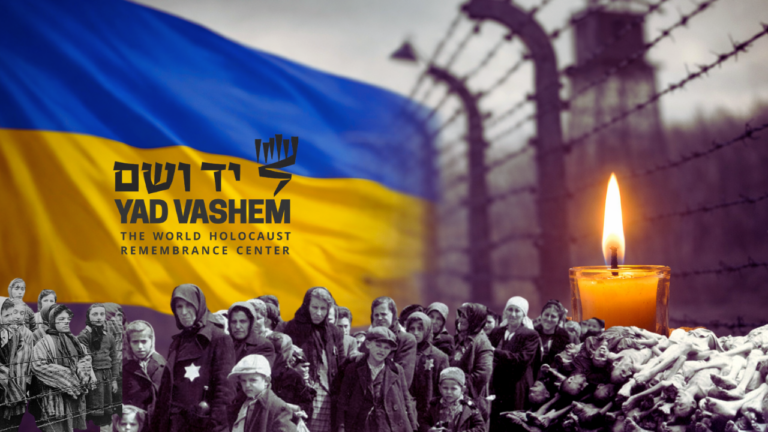
The photographs incorporated in the article were taken from Yad Vashem archives and from social media in Ukraine, and were used in accordance with Section 27A.