
Dim Amor
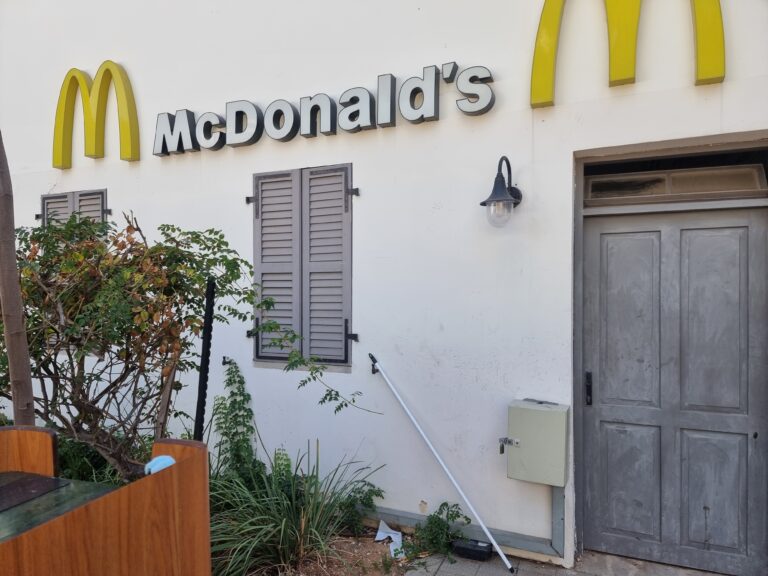
The editorial team of "Maakav" reveals shocking documentation from the McDonald's branch in Sarona, Tel Aviv – one of the chain's largest branches in the city center. Photos taken in October 2025 expose a grim picture of severe neglect in cleanliness, food storage in dangerous conditions, blocked access to public restrooms, and damage to environmental quality in Tel Aviv's public space. These findings join a long series of customer complaints, class action lawsuits, and public criticism against the chain in Israel.
The branch located in Sarona, one of Tel Aviv's upscale office districts, has become a place customers describe as a "giant dumpster". Documentation conducted by the "Maakav" editorial team shows an extremely neglected and dirty branch, with garbage accumulating in every corner. The problem is particularly serious because this branch has outdoor tables in the public park, so the waste and garbage harm not only customers but also the environmental quality and the city's public space.
The garbage and waste from McDonald's Sarona don't stay inside the branch. They spread across the public park area, creating a serious environmental hazard and damaging the urban landscape. The responsibility for this lies entirely with the branch management, which cannot – or does not want to – maintain a minimum level of cleanliness. Tel Aviv's public space is turning into the chain's private dump, without any intervention from the branch management.
But the cleanliness problem is just the tip of the iceberg. The photos revealed a particularly disturbing finding – food products requiring refrigeration, such as caramel, were left on the counter for a long time without any cooling. These products are meant to be stored at low temperatures, and leaving them at room temperature poses a real health risk to customers. What's even more disturbing – it doesn't appear that any of the staff members were concerned about this or bothered to return the products to refrigeration. According to documents in the possession of the "Maakav" editorial team, employees likely used these products afterwards, despite their exposure to inappropriate temperatures.
Documentation in the food preparation area reveals another discouraging picture. The area appears unclean, unaesthetic, and unhygienic. Part of the staff doesn't work with gloves when preparing food, despite this being a basic hygiene requirement. One worker was particularly documented working with a mask but without gloves – an especially strange situation when it comes to October 2025, a period when there is no longer a requirement for masks due to coronavirus. Is the worker sick and prefers not to infect the environment? Is he simply afraid of diseases or does he have a weak immune system? While there is no legal prohibition on working with a mask, the combination of a mask without gloves raises many questions about hygiene standards at the location.
Another problem documented by the "Maakav" editorial team is the blocking of access to restrooms. On the day of filming, the branch's restrooms were completely blocked by Wolt delivery drivers who were standing in place. This situation prevented regular customers from using the restrooms, and more seriously – people with disabilities also couldn't access the accessible restrooms. Blocking access to public restrooms, and particularly for people with disabilities, is a serious violation of public rights and accessibility laws in Israel. The delivery drivers blocked the entire passage, and the branch management did nothing to resolve the situation.
The findings of the "Maakav" editorial team are not surprising when examining customer reviews. The branch holds a particularly low rating of 3.4 out of 5 on Google Business. Although this rating is not the lowest among the chain's branches – the Central Station branch holds an even worse rating of 2.8 – this doesn't make the situation better. The reviews themselves tell a difficult story of poor service, poor food, and ignoring customers.
Omer Nuri wrote in his review: "I ordered a nuggets meal, the fries feel like yesterday's, cold, dry and not tasty. I told the worker, he said there's nothing to do, it just came out of the oil. Also, I drank Coke Zero, after three sips it ran out, I didn't understand why because it's a medium cup, and I discovered the cup was packed with ice to the top, and I told the worker, she said it's not her problem and this is insolence, disgusting service, I won't return there, crazy insolence". This description reveals not only a food quality problem but also a dismissive attitude of employees toward customers who dare to complain about stale food and a drink that's almost entirely ice.
Eldad Barner described a similar experience of poor service: "The worst service I received, they forgot several items in the orders, ignored me when I approached them – they simply started after I approached them a conversation with a colleague in front of me and ignored me – seating areas are dirty, trash cans are full". Here too, a picture emerges of complete disregard for the customer, poor cleanliness, and service below all criticism. Employees prefer to chat among themselves rather than deal with the customer waiting for them.
Ido Dovrat expressed deep frustration: "Pathetic branch. The shake machine is broken but they don't bother to remove it from the menu at the self-service station. Then they don't know how to credit me for the shake so instead they credit the entire order and make a new order. They say there's a Minecraft toy and then it turns out there isn't. The cheeseburger comes with unmelted cheese. They send them to heat up and even after the additional heating the cheese isn't melted. They forgot to give a Happy Meal box and packed the items in a bag. Pathetic". The review reveals complete organizational disorder, broken equipment that remains in use, false promises to customers, and food that isn't properly prepared.
Vladislav Yerushevsky described an unpleasant atmosphere: "You hear curses in Arabic from the kitchen, a worker spoke to me rudely. Not like McDonald's in Europe at all". The review points to problems in organizational culture and staff behavior in the kitchen, when customers are exposed to cursing and coarse language.
Aharon Kuritz summarized the situation most clearly: "The place itself is a dumpster, they employ people who don't know how to work. If I could rate 0 I would do it. As usual, nothing new, when will they learn to give service?".
The problems at the Sarona branch are not an isolated incident, but part of a broader pattern of problems accompanying McDonald's in Israel. The chain has been involved in recent years in several class action lawsuits dealing with consumer rights. Already in 2020, a class action lawsuit was filed against Aluniel Ltd., the franchisee of McDonald's in Israel, claiming that the company violated its duty to explain to customers by having app and delivery order prices higher than in-store order prices. Delivery costs that were not properly explained to customers were mentioned, and the company "apparently" acted in a way that misleads the public.
As part of a settlement, customers were offered to choose from three free item options in online orders. However, the most significant lawsuit dealt with a completely different issue – charging for "full meal upsizing" that included an addition and a drink, even though the upsizing was actually not done or was only partially done. The class action lawsuit was filed by Omri Groper, and the court partially approved the request for approval of the lawsuit as a class action.
On August 21, 2022, the Tel Aviv District Court validated a settlement agreement between the parties. According to the arrangement approved on November 19, 2023, the total compensation value stood at 1.3 million shekels and was supposed to be given to customers over a period of 18 months. The company denied the claims but agreed to a settlement after a mediation process before retired Judge Yitzhak Anbar, without admitting responsibility.
The settlement terms included an automatic compensation mechanism: every customer who orders a meal that includes a water bottle will receive compensation accordingly – a 500 milliliter bottle will be replaced with a 750 milliliter bottle, a 750 milliliter bottle will be replaced with a one-liter bottle, and a one-liter bottle will earn the customer a discount of one shekel. The compensation was supposed to be given automatically upon receiving the order, until the total compensation amount was exhausted. If the amount wasn't fully used, its remainder was supposed to be transferred to the public fund according to Section 27a of the Class Actions Law. The court gave the arrangement the force of a judgment, determining res judicata – meaning, an absolute end to all claims on this issue by group members.
In addition to consumer lawsuits, a request was once submitted to approve a class action lawsuit against McDonald's franchisee in Israel claiming "serious and ongoing neglect in branch cleanliness". The findings of the "Maakav" editorial team raise suspicion that the problem hasn't been solved, at least not at the Sarona branch.
In 2024, a significant turning point occurred – McDonald's Corporation, the main American company, announced it would purchase all 225 branches in Israel from franchisee Aluniel. Media outlets interpreted this as part of the effects of boycotts and public pressures on the chain in Israel and worldwide.
International pressures began in November-December 2023, when it was reported that McDonald's franchisee in Israel provided thousands of free meals to IDF soldiers. This move led to protests from various groups and calls for international boycotts against the chain. McDonald's central company announced that this is a "significant impact" on the market in the Middle East region, and international performance is expected to be affected. The transfer of ownership of branches in Israel from the local franchisee to the main American company was perceived as an attempt to minimize brand damage.
Broad criticism of the chain also exists in the context of consumer rights and sanctions. On the Wikipedia website, in the entry on criticism of McDonald's, it was noted that the chain was also criticized for working conditions, food quality, environmental impact, and more. On the Israeli-consumer level, the process that led to the lawsuit settlement shows that even in Israel there is awareness of possible harm to consumer rights. A Reuters article published that the chain was criticized for providing free meals to soldiers, and calls to examine impact on sales and on the brand were also mentioned.
In another report, it was written that the chain in the United States was required to pay compensation of about $800,000 to a girl who was burned by a hot nugget at a McDonald's branch in Florida. This story recalls the famous case of Stella Liebeck who received serious burns from McDonald's coffee in 1992, and it shows that safety problems in food quality and temperature are not new to the chain.
The "Maakav" editorial team sent the Sarona branch a detailed inquiry regarding all the serious allegations that were documented. The inquiry included findings about cleanliness, food storage, restroom blocking, hygiene conditions in the food preparation area, and damage to the public environment. The branch management's response was brief and evasive: "I'll respond" – and that's it. There was no attempt to deal with the allegations, no promise to fix the situation, no apology to customers. Just two words whose purpose is apparently to show that the inquiry was received, but without any intention to do anything about it.
This response is not surprising when examining the overall picture. A branch that is in such a poor state, which customers describe as a "dumpster", and where no one is interested in fixing the situation despite the problems being obvious to all, is unlikely to respond seriously to inquiries. The branch management – or perhaps the entire chain's management – prefers to ignore the problems, continue operating as usual, and hope that customers will continue to come despite everything. This approach is not just irresponsibility toward consumers, but also a health and environmental risk.
The central question arising from the investigation is: who is supposed to supervise this situation? The Ministry of Health is responsible for checking hygiene standards in restaurants, but it's clear that if such inspections are done, they are insufficient or done at too low a frequency. The municipality is supposed to be responsible for cleanliness in public areas, but apparently there is no supervision of the garbage that McDonald's scatters in the park. The chain itself – which has moved from the local franchisee to American company control – should be interested in maintaining its reputation, but it seems that's not enough.
The findings of the "Maakav" editorial team are not just an exposure of problems at a single branch. They expose a systemic failure – the chain's failure to maintain standards, regulators' failure to supervise, and the public's failure that continues to come to this place despite all warnings. Customer reviews tell the story clearly: stale food, poor service, ignoring complaints, shocking cleanliness. And still, the branch continues to operate, without any significant change.
Class action lawsuits filed in the past against the chain ended in settlement arrangements, but it appears they didn't lead to a substantial change in the company's conduct. Within the framework of the agreements, the chain committed to compensate customers for cases of meal non-upsizing and the like.
The lessons from this investigation go beyond a single branch or a single chain. They speak of a culture of indifference – indifference of business owners to consumer rights, indifference of regulators to law enforcement, and indifference of the public to the conditions in which it consumes food. As long as the public continues to come to such places, as long as regulators don't enforce standards carefully, and as long as chains can "get out" with settlement arrangements without admitting responsibility – the situation won't change.
The McDonald's branch in Sarona is not just a case of negligence in cleanliness. It's a symbol of an entire system that has failed – a system in which large food chains can ignore health and safety standards, claim "I'll respond" in response to serious complaints, and continue to operate as if nothing happened. Consumers come, receive poor service and poor quality food, complain in reviews, and ultimately – nothing changes. The chain continues to generate profits, employees continue to work in the same conditions, and the branch continues to be a "giant dumpster", in the words of one of the customers.
The documentation conducted by the "Maakav" editorial team leaves many questions open. Will the Ministry of Health conduct a thorough inspection of the branch? Will the municipality demand that the chain maintain cleanliness in the public space? Will customers stop coming until the situation improves? The answers to these questions will determine whether this investigation will lead to real change, or whether it will join the long list of exposés that leave the system as it is – broken, indifferent, and functioning only for profit, not for the consumer.
Those who visit the McDonald's Sarona branch in the coming days will be able to see for themselves whether the situation has changed. Are the tables cleaner? Is the food stored properly in refrigeration? Are the restrooms accessible to everyone? Has the garbage stopped spreading in the public park? Do employees work with gloves? Is there a real response to complaints, and not just "I'll respond"? The answers to these questions will determine whether the investigation succeeded in bringing about change, or whether it remained another article that people read, get a little angry about, and forget. The ball is now in the court of McDonald's, the regulators, and the consumers themselves.