



Dim Amor
At 12:00 noon today (Friday), the ceasefire in the Gaza Strip officially went into effect, bringing an end to the war that lasted for many months.
IDF forces completed their withdrawal to the new deployment lines in accordance with the ceasefire and hostage return agreement signed between the parties. With the agreement taking effect, a 72-hour countdown began, at the end of which Hamas is expected to begin returning the first hostages to Israel.
According to the agreed-upon timetable, the hostages are expected to be released next Monday.
The IDF Spokesperson announced this morning that starting at 12:00, IDF forces positioned themselves at the updated deployment lines, in accordance with the agreement framework. Southern Command forces are deployed throughout the area and will continue to operate to remove any immediate threat, according to the official statement. In a separate announcement, the IDF Spokesperson detailed the massive logistics operation carried out overnight, as Southern Command technology and logistics personnel engaged in a large-scale operation that transferred forces to predetermined lines and positions. Alongside reorganizing the territory, full logistical, medical, and maintenance support is being provided to all forces.
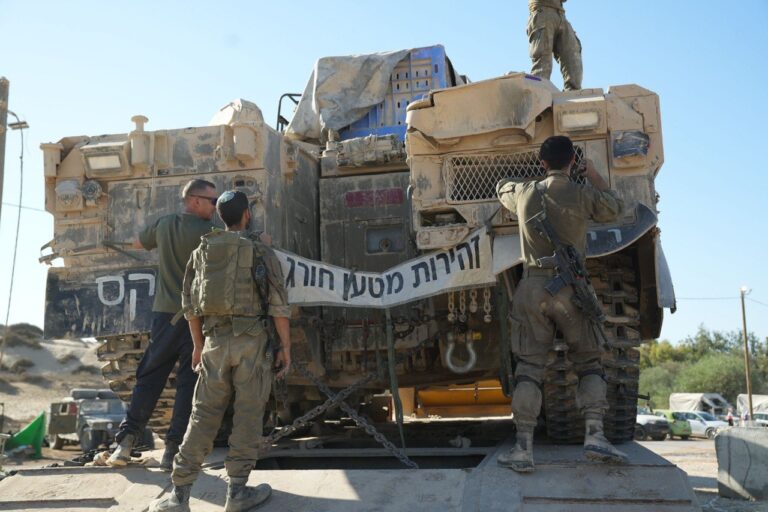
The logistics operation, one of the largest the IDF has ever conducted, included dismantling thousands of different types of infrastructure that had been established in the Strip over the past year. Among the dismantled infrastructure: industrial generators, communications antennas, soldiers' living quarters, observation and surveillance equipment, combat positions, and additional military equipment. The massive logistics operation involved hundreds of trucks, bulldozers, and various types of engineering equipment that worked throughout the night evacuating equipment and infrastructure from existing outposts and strongholds. According to the IDF Spokesperson, technology and maintenance personnel are currently working to increase the readiness of technological tools and equipment and are establishing appropriate infrastructure for staying on the new defense line.
IDF forces are positioning themselves in new strongholds established in the reinforced buffer zone near the Israeli border. However, testimonies from officers in Southern Command reveal new details regarding the location of the strongholds. According to the testimonies, at least two of the new outposts being established near the border are located further east than the yellow line on maps published by the political echelon. The IDF, as a professional body, has so far not officially addressed the withdrawal line, on orders from the political echelon.
According to information received, there are at least two new outposts whose adjusted location, apparently at Hamas's demand during negotiations, is not on the main north-south axis of the Gaza Strip, known as Tancher or Salah al-Din or by its Hebrew designation Route 17, but rather more on Route 70 closer to the Israeli border. This refers to the area parallel to Kibbutz Be'eri in the northern Strip, where until yesterday the bisection axis known as Netzarim was located. This change in outpost location may indicate a tactical compromise required during the formulation of the final agreement.
The 188th Brigade, one of the main units that fought in the Strip, sent a message to its soldiers stating: "Time to hold our heads high with pride". The message reflects mixed emotions among forces on the ground – the war's end on one hand, and withdrawal from outposts they captured and fought in over the past year on the other.
In the shadow of the ceasefire arrangement, the name of an IDF soldier who fell on Thursday in northern Gaza, just one day before the ceasefire took effect, was cleared for publication today. He is Staff Sergeant (Res.) Michael Mordechai Nahmani, 26, from Dimona, a technology and maintenance soldier in the 614th Combat Engineering Battalion. Nahmani fell in battle in northern Gaza on Thursday, October 9, 2025, on the 17th of Tishrei 5786. Notification of his death was given to his family, and he was posthumously promoted from Sergeant (Res.) to Staff Sergeant (Res.). The IDF announced it shares in the family's grief and will continue to accompany them.
Nahmani's death on the last day of fighting underscores the heavy price paid by IDF forces even in the final days of the war. As a technology and maintenance soldier, Nahmani was part of the logistical and operational effort that enabled continued fighting in the Strip and was likely involved in operations carried out in recent days before the ceasefire.
The logistics operation carried out last night is considered one of the most complex the IDF has executed during the war. The evacuation of thousands of items, heavy equipment, and permanent infrastructure from dozens of outposts deployed along the Strip was transferred within a short timeframe while maintaining operational readiness and avoiding escalation with terrorist organizations in the Strip. The operation required precise coordination between different units, including combat units responsible for security, combat engineering units that handled infrastructure dismantling, and logistics units responsible for transport and evacuation.
Now, with the ceasefire taking effect, all eyes are turned to the coming days. According to the agreement, Hamas is supposed to return the first hostages within 72 hours of the ceasefire taking effect, meaning by next Monday. The wait for implementation of the agreement's first phase will be a critical test for implementing the entire agreement and continuing the process.
IDF forces continue to be positioned along the border with the Gaza Strip, in new strongholds established in the reinforced buffer zone. According to official statements, forces will continue to operate to remove any immediate threat and maintain the security of residents near the border. The transition from intensive combat to a ceasefire situation requires operational and psychological adjustments from forces who fought in the Strip for about a year.
The massive logistics operation, which included transferring forces, dismantling infrastructure, and establishing new outposts, officially ends today with forces positioning themselves at the new deployment lines. Technology and maintenance personnel continue working on establishing infrastructure in the new strongholds, including preparing communications systems, observation equipment, and combat equipment. The goal is to ensure forces are prepared to respond to any possible scenario while maintaining the ceasefire agreement.
The coming days will be decisive for the agreement's fate and the question of whether Hamas will indeed honor its commitments to return the hostages. Anticipation among hostage families and the Israeli public is high, and anxiety over the fate of hostages held captive for about a year accompanies every step in the process. The end of the war in the Gaza Strip marks a historic turning point, but the real test will be the ability to implement the agreement and return the hostages to their homes.
Photo: IDF Spokesperson