



Dim Amor
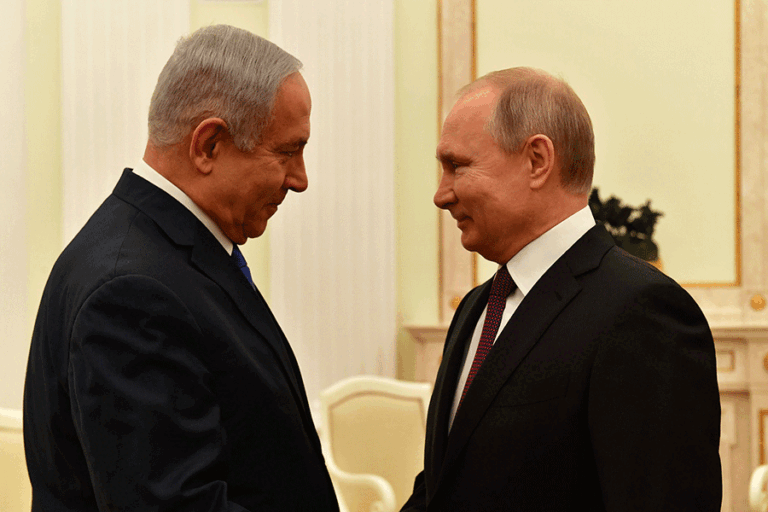
Prime Minister Benjamin Netanyahu held a phone call this evening with Russian President Vladimir Putin – against whom the International Criminal Court in The Hague issued an arrest warrant for war crimes in Ukraine. This is the second conversation between the two in just six weeks, initiated by the Russian side, according to the Prime Minister's Office.
Netanyahu's office statement about the call was extremely brief and avoided details: "Prime Minister Benjamin Netanyahu spoke this evening with Russian President Vladimir Putin. The call took place at President Putin's initiative and in continuation of a series of previous conversations in recent times, which dealt with regional issues". In contrast, the Kremlin's statement was far more detailed and revealed the true agenda of the conversation.
According to Moscow's version, "Vladimir Putin held a phone call with Israeli Prime Minister Benjamin Netanyahu. They held a detailed exchange of views on the situation in the Middle East, including developments in the Gaza Strip in the context of the ceasefire agreement and prisoner exchange, the situation around Iran's nuclear program, and issues of promoting further stabilization in Syria". These are highly sensitive topics for Israel, discussed with a leader whose country supports terrorist organizations and has even officially recognized a Palestinian state.
Relations between Israel and Russia completely collapsed after October 7th. Putin and the Russian government supported Hamas following the massacre, and today the terrorist organizations Hamas and Hezbollah are considered completely legitimate organizations on Russian territory. Moreover, Russia declared its recognition of the State of Palestine and even opened a Russian embassy in the Palestinian state. Moscow does not recognize Jerusalem as Israel's capital, and considers Tel Aviv to be the capital city.
Despite all this, it is reasonable to assume that both sides now have a common interest regarding the Syrian arena – to prevent or at least reduce the growing influence of Turkey, which is very close to the new Syrian regime. While Israel fears the strengthening of Turkey's grip in Syria, which could threaten its northern borders, Russia sees Turkey as a regional rival that could harm Russian interests in Syria.
For Israel, the conversation with Putin also serves another critical purpose – to ascertain whether Russia intends to assist Iran in restoring its air capabilities after the twelve-day war, or perhaps even in the nuclear sphere. The answer to these questions could be decisive for Israel's strategic decisions in the Middle East.
However, the public question arising from the conversation is particularly sharp: why does the Israeli Prime Minister, himself under an arrest warrant from the same international court, maintain ongoing dialogue with a leader who is also wanted by the same tribunal for war crimes, and whose government supports Israel's sworn enemies? The answer apparently lies in the cold pragmatism of international politics, where national interests override ethical or moral considerations. The conversations with Putin continue, despite everything.
Photo: Kobi Gideon, GPO – from the Prime Minister's Office website; use according to Section 27a.