



The Monetary Committee of the Bank of Israel decided on September 29, 2025, to keep the interest rate unchanged at 4.5 percent, against the backdrop of a high geopolitical uncertainty environment stemming from intensifying combat in Gaza and deteriorating international sentiment toward Israel. This decision reflects the economic complexity the Israeli economy is confronting, as inflation remains in the upper portion of the target range and the labor market continues to be tight.
The inflation rate over the past twelve months declined slightly and stood at 2.9 percent, in the upper portion of the Bank of Israel's target range. The Consumer Price Index for August rose by 0.7 percent, with inflation characterized by significant volatility since the beginning of the year. Excluding energy, fruits, and vegetables, the annual inflation rate stood at 3.4 percent. In August, the annual inflation rate of non-tradable components stood at 3.6 percent, while the annual rate of tradable components inflation fell to 1.7 percent.
Forecasters expect that in the coming months annual inflation will remain close to the upper boundary of the target, and may even exceed it, and will begin to moderate only at the beginning of 2026. Inflation expectations one year forward from various sources are around the center of the target range, and expectations for the second year and beyond also continue to remain near the center of the target. In the Monetary Committee's assessment, there are several risks of possible acceleration in inflation, including geopolitical developments and their effects on economic activity, rising demand alongside supply constraints, fiscal developments, and deterioration in global terms of trade.
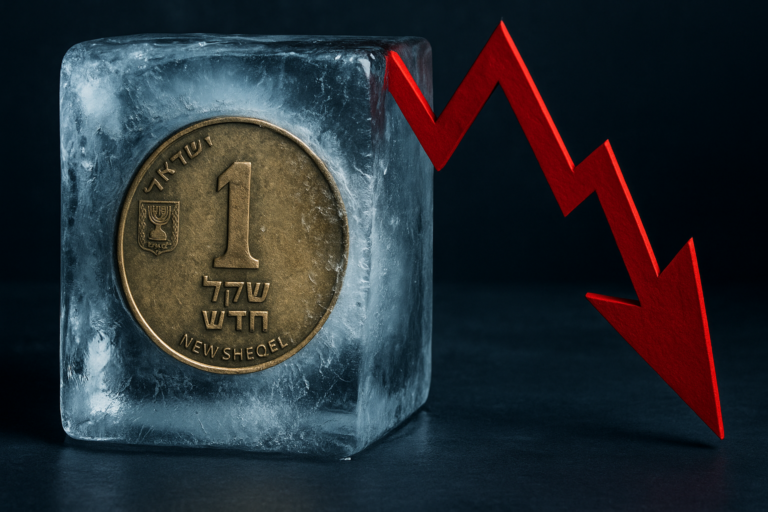
Since the last interest rate decision, the shekel appreciated by one percent against the dollar and 0.8 percent against the euro. In nominal effective terms, the shekel appreciated by 1.2 percent. The strengthening of the shekel comes against the backdrop of continued fighting and uncertainty in the economy.
The Research Department of the Bank of Israel updated the macroeconomic forecast, a forecast characterized by a high level of uncertainty. The forecast was formulated after extensive reserve mobilization and the beginning of a significant ground operation in the Gaza Strip, and under the assumption that fighting in Gaza will continue at varying intensity and conclude during the first quarter of 2026. According to the department's assessment, in this scenario GDP is expected to grow by 2.5 percent and 4.7 percent in 2025 and 2026 respectively, compared to 3.3 percent and 4.6 percent in the July forecast. In these years, the broad unemployment rate in prime working ages is expected to average 3.4 percent.
The inflation rate during 2025 is expected to stand at three percent, and during 2026 at 2.2 percent, compared to 2.6 percent in 2025 and 2 percent in 2026 in the July forecast. The government budget deficit is expected to total 5.1 percent of GDP in 2025 and 4.3 percent in 2026, and the debt-to-GDP ratio is expected to stand at approximately 71 percent at the end of 2025 and 2026.
The uncertainty in this forecast is manifested in a particularly wide range of security scenarios that constitute risks to the forecast in both directions. Downside risk to the forecast could stem from further prolongation of the fighting in which supply constraints and damage to sentiment toward Israel continue, a situation that will continue to cast a shadow on investments and activity recovery, resulting in lower growth and an expanded state budget deficit. Conversely, in recent days negotiations are taking place that may ripen into a ceasefire agreement and even an end to the war, which would ease supply constraints in the economy and support expansion of activity.
Current indicators of economic activity in the economy in August indicate continued moderate recovery of activity. Credit card spending data in current prices point to continued recovery following the sharp decline with the outbreak of Operation Am Kelvia, and in the latest data they remain at a level slightly above the trend line. The aggregate balance in the Central Bureau of Statistics' business trends survey for August continued to rise but has not yet returned to the level preceding Operation Am Kelvia. Capital raising in the high-tech sector in the third quarter of the year was high and similar to its level in the previous quarter.
The surplus in the goods and services account declined sharply in the second quarter of the year due to a decrease in exports of goods and services and an increase in imports of goods and services; in the latest data there has been recovery in exports as well. The cumulative state budget deficit over the last 12 months totaled 4.8 percent of GDP in August, a slight decrease from the previous month, against the backdrop of continued increase in government tax revenues in August which are at a high level compared to the long-term trend. The government approved an additional increase in the defense budget of 31.9 billion shekels in 2025, primarily to finance defense expenditures for Operations Merkavot Gideon and Am Kelvia.
The labor market remains tight primarily due to labor supply constraints resulting from reserve mobilization and shortage of non-Israeli workers. The broad unemployment rate of prime working ages declined and stood at 3.1 percent in August. The job vacancy rate rose slightly in August and stood at 4.5 percent. The rate of those temporarily absent due to reserve service in August stood at 0.7 percent. The employment rate and participation rate of prime working ages are at a low level and even declined in July and August. Wage increases continue throughout the economy, with wages growing by 4.2 percent in annual terms from May through July compared to the third quarter of 2023, led by wages in the business sector.
Activity in the construction sector shows a mixed picture in the second quarter of 2025. Seasonally adjusted, the number of housing starts and building permits continued to rise and remained high in annual terms, so that the scope of activity in the sector continues to be significant. On the other hand, the volume of construction completions remained relatively low with continued lengthening of average construction time which reached 36 months, reflecting the persistent shortage of workers in the sector. According to Central Bureau of Statistics data for July, the inventory of unsold apartments continued to rise and has been in an upward trend since April 2022. Simultaneously, the downward trend in the number of apartment transactions continued, particularly in new apartments. Since the beginning of the year, apartment prices have fallen by 1.4 percent cumulatively, and the annual rate of price increase moderated and stood at 1.6 percent. The owner-occupied housing services item in August continued to rise at an annual rate of 4.3 percent, indicating some stickiness. In August, mortgages totaling approximately 9.1 billion shekels were issued.
Following a sharp rise in recent months, local stock indices continued to rise amid high volatility. Israel's risk premium, as reflected in the national credit risk spread, remained essentially unchanged during the period under review, but it still remains at a level higher than before the Iron Swords War, and spreads on dollar-denominated government bonds remained essentially unchanged. The yield on 10-year shekel government bonds rose slightly during the period under review. Credit to the business sector expanded at a high rate, and in July credit to medium and small businesses also continued to grow. The rate of business credit in arrears over 90 days remained relatively low. According to the trends survey for August, the proportion of businesses reporting severe credit constraints in various sectors is similar to its level on the eve of the Iron Swords War.
Global economic activity is characterized by a mixed trend. In the United States, economic uncertainty following the administration's tariff policy and immigration policy has led to signs of slowdown in the labor market. In the eurozone and China, recovery in activity was recorded. The global growth forecast was updated slightly upward, and the global purchasing managers' index for August rose slightly. The pace of expansion in global trade continues to slow.
Growth data for the second quarter in the United States were revised upward and stand at 3.8 percent. Labor market data for August continued to indicate weakening, with job additions in August significantly lower than forecasts and data for June and July also revised downward. The unemployment rate continued to rise and reached approximately 4.3 percent. In the eurozone, slight improvement is evident in sentiment indices, with improvement notable in the zone's leading countries, particularly Spain. In China, some recovery in activity was recorded in light of easing in the trade war, and the volume of goods exports from China maintains a stable level.
In the United States, inflation is sticky and its rate according to the overall index in August rose to 2.9 percent. The core consumer price index remained unchanged at 3.1 percent. In the eurozone, the services component continues to moderate and support the slowdown in inflation; in the final reading for August, inflation remained unchanged at two percent and the core index remained unchanged at 2.3 percent. The Federal Reserve lowered the interest rate by 25 basis points as expected, and the European Central Bank left the interest rate unchanged once again.
The summary of monetary discussions held prior to this decision will be published on October 12, 2025, and the next monetary policy decision will be published on Monday, November 24, 2025.