


Dim Amor
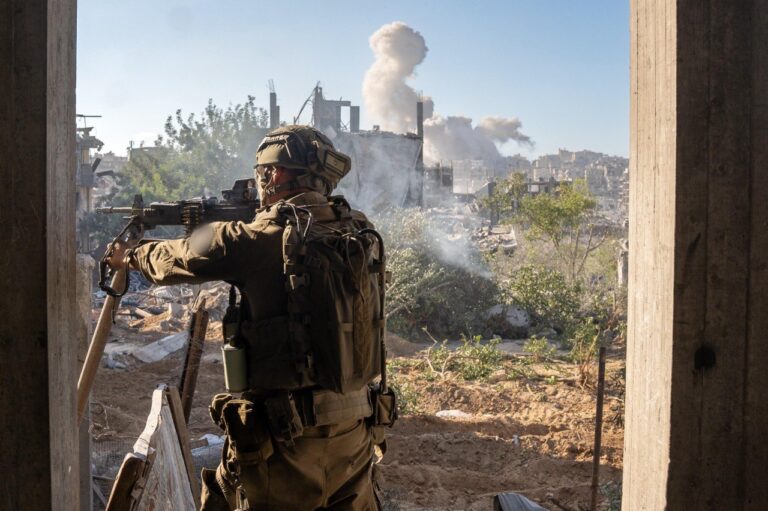
A year and a half after IDF forces evacuated the neighborhoods in western Gaza City, tanks and fighters returned last night to those same destroyed streets – this time facing new and sophisticated explosive traps that Hamas had concealed in the rubble. The new maneuvering operation in Gaza City opened with 100 airstrikes in the initial hours, dozens of them against explosive sites identified during the night on the city's main streets.
An armored force advanced under cover of darkness toward the center of Gaza City, and Merkava tanks crossed for the first time in many months the narrow streets between the damaged multi-story buildings. At a critical moment, just before the tanks approached a street intersection where a massive explosive site was identified, an Apache attack helicopter appeared overhead and struck the location.
"Everything went up in the air there, and we immediately bombed the area to ensure that no terrorist lifts his head or even thinks of running to the tanks to attach or throw an explosive device at them", explains Colonel G., head of the Border Defense Squadron responsible in the Air Force for coordination with ground forces. "The biggest challenge will be doing all this when the hostages are in the area".
Of the hundred strikes carried out by the Air Force in the operation's initial hours, dozens were directed against explosive sites identified during the night. The tactical picture emerging indicates a dramatic change in Hamas's combat methods, which learned from previous battles and adapted itself to the new conditions.
The terrorists succeeded in concealing a large portion of the explosives within building rubble, or on upper floors of damaged structures. They carved into external walls, plastered and painted in such a sophisticated manner that it's almost impossible to detect with the naked eye. Some of the terrorists used empty IDF ammunition boxes that army forces had left behind by the hundreds and even thousands, in all the neighborhoods where the army operated during nearly two years of fighting.
Hamas terrorists filled the empty ammunition boxes, known by the nickname "Brusim", with concrete and embedded high-powered explosives within it. The terrorist organization also prepared with tiny and hidden cameras for surveillance and remote detonation of the devices. Some of these explosive sites are even camouflaged with "green energy" – Hamas connected electricity to them from innocent-looking solar panels, which also became a focus of aerial hunting.
The Air Force eliminated hundreds of terrorists in the past two weeks, in a manner that also disrupted the deployment of new terrorist infrastructure. The intensified aerial activity is designed to prevent terrorists from activating the traps against advancing forces, while simultaneously enabling controlled and relatively safe penetration of ground forces into the surrounded territory.
Chief of General Staff Major General Eyal Zamir declared today in the Strip: "The IDF is the people's army, that is the source of its strength. As the army's commander, it is my duty to present before every operation all possible security implications. All risks and opportunities were presented to the political echelon clearly and professionally. Now, we are deepening the achievement that will enable bringing the war's end closer".
"Returning our hostages is a war objective and a national and moral commitment", the Chief of General Staff added, "even in these days, when the people of Israel are about to gather around the holiday table, our soldiers are positioned in defense and attack from a sense of mission and deep commitment to the people – unity and comradeship that have no substitute".
The new operation places the IDF before a dual and complex challenge: on one hand neutralizing the sophisticated explosive traps that Hamas concealed, and on the other hand operating with maximum caution in areas where Israeli hostages might be located. The combination between the need to protect its forces and the mission to return the hostages creates a complex operational reality that requires close coordination between the army's different branches.
The new maneuver takes place against the backdrop of ongoing diplomatic efforts to achieve a hostage deal, but the IDF continues to prepare for all possible scenarios. The ground forces operate with close support from the Air Force, which provides continuous defensive coverage and precise strikes on terrorist targets identified in real-time.
Photo: IDF Spokesperson