

Dim Amor
Haifa Municipality, under the management of Mayor Yona Yahav—who is also entrusted with safeguarding public funds—conducted legal proceedings against me, which ended in a particularly embarrassing result for the municipality. Judge Kamila Jid'on unequivocally dismissed the lawsuit and ruled in her verdict: "After reviewing the application, and in the absence of a response from the plaintiff to this day in accordance with the decision of 19.08.2025, I hereby order the dismissal of the lawsuit". Therefore, it is appropriate to ask: how are public funds managed in Haifa under Yona Yahav's leadership?
A continuing saga of about a year came to its dramatic end this week, with the court's decision to dismiss the lawsuit filed by Haifa Municipality against the undersigned – in fulfilling his journalistic role – and against "Ma'akav" publication, in the amount of half a million shekels. This lawsuit, which aroused sharp public criticism and was defined as a "silencing lawsuit", was filed following the publication of an investigation in "Ma'akav" publication, which exposed the wild boar hunting activity in Haifa city limits and the sale of their meat contrary to law.
On September 4, 2025, Judge Kamila Jid'on published her final verdict. The court ruling explicitly stated that apparently Haifa Municipality demonstrated contempt for the court and did not respect its decisions, and therefore the lawsuit was dismissed. The judge also emphasized that despite her decision of July 22, 2025, which required the municipality to submit its position regarding the continuation of the procedure, the plaintiff chose to ignore the court's orders. The struggle for freedom of expression was conducted consistently and determinedly – and was ultimately decided by a decisive victory in court.
The lawsuit represents a shocking waste of public funds. Haifa Municipality paid thousands of shekels as court fees and employed no less than 35 lawyers to handle the case. All this to sue a journalist who exposed problematic activity in public fund management and resident safety. Journalist Dim Amor, who represented himself in court, managed to defeat the municipality's giant legal system.
The case began with an investigation published by "Ma'akav" publication that exposed disturbing practices in wild boar hunting activity in Haifa. The investigation revealed that within the framework of a "thinning" operation initiated by Haifa Municipality, wild boars were hunted indiscriminately – including pregnant sows and young piglets. The most disturbing finding was the discovery that a kilogram of wild boar meat was sold for 30 shekels, which turned the municipal operation into a profitable business for hunters.
The investigation exposed how meat that had not undergone any supervision or veterinary examination reached residents' plates, despite Haifa Municipality itself claiming that the boars carry dangerous diseases such as tularemia and antibiotic-resistant bacteria. The investigation also raised serious questions regarding tender processes and supervision of contractors employed in hunting activity.
Within the framework of the investigation, disturbing testimonies were revealed regarding the manner of conducting the "thinning". Hunters were observed shooting indiscriminately at boars of all ages, violating the agreement with the Nature and Parks Authority that required focusing on old and sick boars only. Residents reported nighttime shooting and the presence of masked hunters in populated areas, which raised security concerns.
Haifa Municipality's response to the investigation was harsh. Instead of dealing with the findings and explaining its conduct, the municipality chose to sue the journalist and "Ma'akav" publication for half a million shekels. The lawsuit received widespread criticism as a "silencing lawsuit" – an attempt to block journalistic criticism through economic and legal pressure.
In the written defense submitted on April 10, 2025, principled arguments were presented that go beyond the concrete dispute. It was argued that this is a clear silencing lawsuit, whose purpose is to prevent free public criticism and harm the principle of press freedom. It was also emphasized that all publications relied on reliable sources, official documents and public discussions held in the Knesset.
The defense pointed out that there is no evidence of damage caused to the municipality by the publications, and that the lawsuit amount is absurd and disproportionate. It was also argued that the very use of public funds to finance a lawsuit whose purpose is to silence a journalist is serious in itself and contradicts basic democratic principles.
The legal arguments in the defense focused on the recognized defenses in the prohibition of libel law: truth in publication and good faith. The defense emphasized that the issue was discussed publicly in the Knesset, where various Knesset members warned of serious deficiencies in livestock management in Haifa. When the issue is discussed publicly in the Knesset, there is no place to claim that journalistic publications on the subject constitute libel.
During the legal proceedings, an embarrassing picture of public fund management in Haifa Municipality was revealed. The municipality paid court fees, spent tens of thousands of shekels on lawyers' fees, and allocated extensive resources to a legal battle whose sole purpose was to silence journalistic criticism. All this instead of dealing with the problems raised in the investigation and improving supervision of municipal activities.
The case sparked widespread discussion about the use of silencing lawsuits against journalists in Israel. Legal sources noted that this is a disturbing phenomenon where public bodies exploit their economic advantage to deter journalists from engaging in criticism. The use of public funds to finance such lawsuits exacerbates the problem and creates a perverse incentive for public bodies.
Haifa Municipality's conduct during the legal proceedings was no less problematic than the lawsuit itself. From the municipality's legal conduct, it can be clearly concluded that it demonstrated contempt for the court and did not respect its decisions. This ignoring of court orders reflects a disturbing attitude toward the judicial system and toward the rules of democratic play.
On July 22, 2025, Judge Kamila Jid'on ordered Haifa Municipality to submit its response regarding the continuation of the procedure. Subsequently, on August 19, 2025, an additional decision was issued by the court. Despite this, the municipality chose to ignore the repeated decisions – conduct that ultimately led to the dismissal of the lawsuit.
This course of action raises serious questions regarding the degree of respect the municipality has for the judicial system and the rule of law. Refraining from providing a response to several decisions constitutes an expression of contempt for the court, waste of public funds and damage to precious judicial time – and all the more so given the fact that Haifa Municipality itself initiated the procedure from the outset and therefore was obligated to respond to it.
The case before us particularly illustrates the vital need to protect press freedom from silencing attempts. The investigation published by "Ma'akav" publication dealt with substantial public issues of the first degree: public fund management, food safety, supervision of government actions, management of urban centers, animal protection, as well as supervision of contractors on behalf of the municipality. The attempt to silence the journalist who exposed these deficiencies constitutes a direct harm to the public's fundamental right to know.
The investigation exposed not only problems in hunting activity management but also systemic failures in government supervision. The Ministry of Agriculture refrained from taking responsibility for the issue and transferred the handling to the Nature and Parks Authority. On the other hand, the Ministry of Health directed the questions back to the Ministry of Agriculture. This circle of responsibility transfer created a situation where no authority took full responsibility for supervision and safety.
The findings raised serious health concerns. If indeed the boars carry dangerous diseases as claimed by Haifa Municipality, how is it possible that their meat was sold for human consumption without any supervision? This question remained without a meaningful answer from the authorities. The investigation exposed a systemic failure in food safety supervision and animal hunting.
In addition to possible health risks, the investigation also exposed serious concerns in the security field. Haifa residents reported live fire in residential areas and the presence of masked hunters. This situation could serve as convenient ground for exploitation by hostile elements, as terrorists can easily pose as innocent hunters. This is a serious security breach, which does not receive adequate response and serious examination by the competent authorities.
The economic costs of hunting activity were not published in full, but estimates speak of hundreds of thousands of shekels spent from the public budget. Alongside this, the costs of the legal lawsuit – court fees, lawyers' fees, and working time of public employees – added tens of thousands more shekels to the bill paid by the public. All this to try to silence a journalist who exposed public problems.
The final result of the case constitutes a principled victory for press freedom in Israel. The dismissal of the lawsuit sends a clear message that the judicial system cannot be exploited to deter journalists from fulfilling their mission. The court proved that it recognizes the phenomenon of silencing lawsuits and is prepared to act against it.
I, as a journalist who represented himself against Haifa Municipality's legal system (without the assistance of a lawyer), prove that truth and good faith can prevail even over significant power advantage. This victory is not only personal, but constitutes a principled achievement for every journalist fighting silencing attempts by powerful bodies.
The case emphasizes the importance of independent investigative journalism in protecting public interests. "Ma'akav" publication's investigation managed to expose significant problems that did not receive attention from the relevant authorities. Without the journalistic publication, it is reasonable to assume that the problems would have continued without public supervision.
In addition to publishing the investigation (and given the uncompromising stance of activists in Haifa), the issue received attention in the Knesset plenum, where various Knesset members raised sharp questions regarding municipal conduct. These discussions contributed to deepening public awareness of the issue and applied real pressure on authorities to improve supervision and enforcement mechanisms. This expressed a clear example of the vital role of the press as the public's watchdog. Therefore, this is not a personal investigation or expression of my opinion as a journalist only.
The implications of the case far exceed the boundaries of the specific conflict between Haifa Municipality and the journalist, and raise a principled question about freedom of expression and the press. This case creates an important precedent that strengthens the protection of press freedom in Israel, and signals to public bodies that they must carefully consider their steps before trying to silence journalistic criticism through expensive and intimidating legal lawsuits.
The case also demonstrates the importance of public support for independent journalism. "Ma'akav" publication and I as a journalist demonstrate courage in standing against heavy pressure from a powerful public body. Public support in such situations is a vital condition for encouraging other journalists to continue fulfilling their public mission.
The affair also raises questions about the conduct of local politicians in the era of social networks and digital media. The accessibility of information and the ability for rapid publication require a higher level of transparency and accountability than before. Attempts to silence criticism are increasingly perceived as illegitimate by the public.
It should be noted that Haifa Municipality was not content with filing the lawsuit against the journalist, but also refrained from providing a direct response to the questions raised in the investigation. This conduct reflects a deeper problem in the municipality management's attitude toward transparency and accountability to the public. A healthy democracy requires that public bodies be ready for criticism and expose to the public the information concerning their conduct.
The victory in court is only part of the broader struggle for transparency and public accountability. For the victory to be truly meaningful, continuous public monitoring of government conduct and support for independent journalism is required. Only through constant public supervision can it be ensured that public services are provided at the appropriate level.
The municipality's conduct in this affair illustrates how public funds can be wasted when public authorities choose to act from wounded ego, rather than act from accountability to the public. The economic costs of the legal proceedings are just the tip of the iceberg of a broader problem – lack of real willingness to deal with constructive criticism and work to improve performance.
Indeed, the Israeli public enjoys relatively strong press freedom, but this right is not taken for granted. The municipality's conduct in this affair reminds us how vital it is to protect it, and to support journalists who take personal risks to expose truths of public importance. The victory in this affair is not only of the journalist, but of every citizen who believes in the importance of transparency and public accountability.
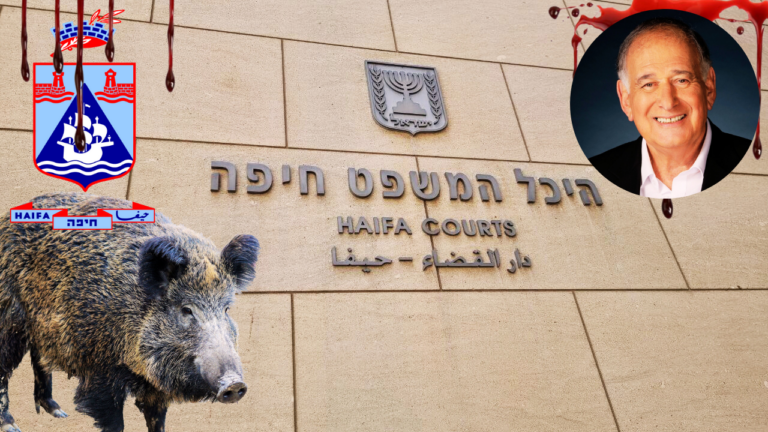
Photo of Yona Yahav: from the mayor's official Facebook page, responsible for the killing policy (animals), use is made in accordance with section 27a of the Copyright Law