
By Dim Amor
On 23 December 2025, a sharp and critical report by the State Comptroller was published, examining the effectiveness of the seam-line barrier and the crossings in the Jerusalem envelope sector. The report presents a complex and troubling security picture that strikes at the core of the protection of Israel’s capital, the surrounding communities, and the State of Israel as a whole. According to the report, the barrier – intended to serve as a physical and operational buffer against the infiltration of terrorists and illegal entrants – fails to provide a continuous, orderly, and comprehensive response to the security threats emanating from the area, despite investments amounting to billions of shekels over the years and the accumulation of extensive operational experience.
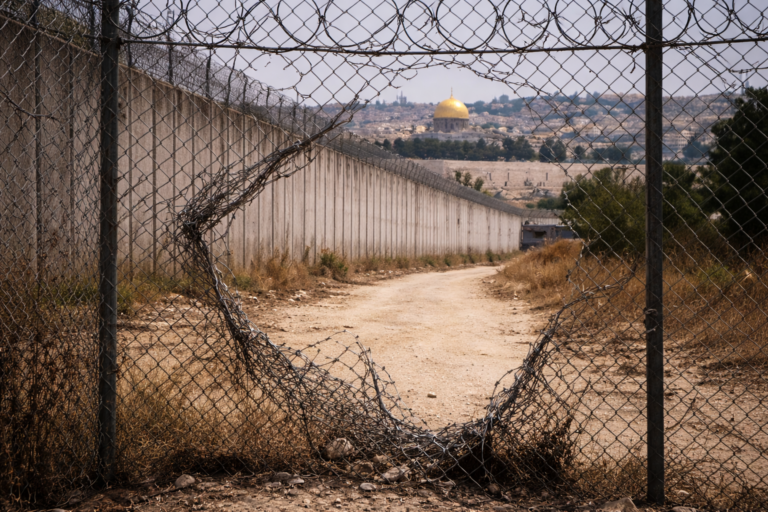
According to the audit’s findings, Palestinians are able to infiltrate Israeli territory without oversight or inspection in several significant segments of the barrier route around Jerusalem. The report emphasizes that this scenario is not merely theoretical: in practice, terrorists have exploited gaps and the absence of a continuous barrier, as occurred in the deadly attack at the Ramot Junction in Jerusalem in September 2025. It further emerges that only about 61% of the seam-line route in the Jerusalem envelope is protected by a wall or fence, while dozens of additional kilometers remain breached or entirely open. The route extends over several hundred kilometers, part of which passes through Judea and Samaria and does not fully overlap with Jerusalem’s municipal jurisdiction. East of the barrier, outside its route, areas remain within the city’s jurisdiction, creating security, operational, and legal complexity simultaneously.
The report stresses that the limited number of lanes at various crossings causes heavy congestion for both pedestrians and vehicles. These bottlenecks, the report states, are not only a disruption to daily life but also constitute a clear security risk, potentially turning the crossings into a "death trap" during emergencies or sudden incidents. Reviewed data indicate that at the Qalandiya crossing, for example, the average waiting time for pedestrians is approximately 80 minutes, while the average waiting time for vehicles reaches about 56 minutes. In 2022, roughly 135,000 pedestrians passed daily through crossings in the Jerusalem envelope. Between 2018 and 2022, the number of crossings increased by approximately 53%, without adequate adaptation of the crossing infrastructure.
From an organizational and operational perspective, the report points to severe deficiencies in coordination and the division of responsibility among the bodies operating in the area. Coordination between the police, the Israel Defense Forces, the Border Police, and the Israel Security Agency is inadequate, and there is no uniform, orderly operational doctrine for the barrier and the crossings. The report finds that the police have managed the crossings for approximately 20 years without a structured operational concept, despite the fact that nearly two decades have passed since a plan approved by the prime minister – formulated by the National Security Council – called for the civilianization of the crossings. Such an operational doctrine was intended to define clear rules, principles, processes, and modes of action, yet in practice no comprehensive, binding doctrine has been formulated or approved.
The report further notes that some of the crossings operated by the police in the Jerusalem envelope lack permanent command. Of the 16 existing crossings, only two commanders have been formally certified in their roles. This situation creates command-and-control gaps, difficulties in routine management, and reduced capacity to respond to exceptional incidents, as well as a discrepancy between the police’s responsibility for operating the crossings and its ability to maintain, upgrade, and adapt them to population growth.
The report also addresses preparedness for extreme scenarios. Until the events of 7 October 2023, the Jerusalem District of the police had no defined reference threat or reference scenario upon which appropriate force-building in the Jerusalem envelope could be based. Only after those events were preparedness orders for simulated scenarios developed, with their preparation completed in August 2024. However, according to the audit, these orders do not provide a full operational response to the entire range of possible risks.
With regard to manpower, the report points to a significant understaffing of civilian security personnel at crossings in the Jerusalem envelope. The Ministry of National Security and the police did not prepare in advance for this shortfall, and with the outbreak of the "Iron Swords" war, many guards were mobilized under emergency call-up orders, further reducing available manpower and impairing the operational capability of the crossings. In addition, the reduction in personnel strength of the Erez Battalion of the Military Police Corps as early as June 2023 resulted in the battalion being able to carry out only about 69% of its assigned missions, while approximately 31% of missions were not carried out at all.
The report includes data indicating the level of security threat in the area. In 2023, 27 deadly terrorist attacks were recorded in the Jerusalem envelope. In addition, there were 10 shooting incidents targeting security forces, 412 Molotov cocktail attacks, 98 explosive-device incidents, and 1,031 stone-throwing incidents. In the first quarter of 2023, 2,427 illegal entrants were apprehended in the Jerusalem envelope, compared with 1,233 in the first quarter of 2024. The report also notes a significant discrepancy between infiltration records maintained by IDF observation command centers and police records, which are based on declarations under the "Turkish Horse" order, during the period from January to May.
The audit also addresses infrastructure issues. Over nearly two decades since the establishment of the crossings, only four of the 16 crossings in the Jerusalem envelope – about 25% – have been upgraded. Since 2021, investment has begun in expanding four additional crossings, but the report notes that this progress is insufficient given the continued growth in the number of users. It is further noted that the Ministry of Transport decided to widen a road adjacent to the Tunnels Crossing without examining the impact on the crossing itself and without coordinating the addition of lanes, contributing to the creation of bottlenecks that pose a security risk to forces operating at the site and to road users.
From a budgetary perspective, the report states that the cost of constructing the barrier in Judea and Samaria, including the Jerusalem envelope barrier, amounts to approximately 8.3 billion shekels. Despite this investment, the report determines that openings remain in the barrier allowing illegal entry from Judea and Samaria into Jerusalem, and that deficiencies relate both to the barrier itself and to the manner in which the crossings are operated.
The audit was conducted between January 2024 and February 2025 and included an extensive review of the authority and responsibility of the Border Police in the Jerusalem envelope, the reference threat and reference scenarios, the effectiveness of the operational response at the barrier, the operational doctrine of the crossings, the heterogeneity of forces operating there, security and inspection procedures, infrastructure adaptation to population growth, and the civilianization of the crossings. The audit was carried out within the police, the IDF, the Ministry of Defense, the Ministry of National Security, the Israel Security Agency, the Ministry of Transport, the Prime Minister’s Office, the National Security Council, the Government Secretariat, and the Jerusalem Municipality. Supplementary audit work continued until July 2025.
In February 2025, a draft of the report was submitted to the prime minister, the minister of defense, the minister of national security, the IDF, and the Israel Police for their responses. Responses from the IDF and the police were received in April and May 2025. However, on 8 September 2025, after the audit had concluded, a deadly terrorist attack occurred at the Ramot Junction, killing six Israelis and injuring approximately ten others. The attack was carried out by terrorists from Palestinian villages in the Ramallah area. The report states that in light of the audit’s findings and this event, the urgency of correcting the deficiencies and implementing the recommendations is further sharpened.
The subcommittee of the Knesset State Control Committee decided not to place the full report before the Knesset plenary, but to publish only parts of it, in order to safeguard state security, in accordance with Section 17 of the State Comptroller Law. Despite this limitation, the published report reveals a long list of systemic, operational, and organizational failures.
In conclusion, the report determines that the seam-line barrier and the crossings in the Jerusalem envelope constitute a central pillar of the security of Jerusalem’s residents and the State of Israel. Their proper functioning is essential for preventing terrorist attacks and infiltration, as well as for ensuring the provision of appropriate services to Israeli citizens, Palestinians, residents of East Jerusalem, and students. However, the deficiencies identified relate to the exercise of responsibility and authority among the various bodies, the continued existence of openings in the barrier, insufficient preparedness for sudden incidents, and the absence of a structured operational doctrine for the crossings. The report emphasizes that correcting these deficiencies is urgently required, while balancing security needs with the preservation of daily life, against the backdrop of ongoing security threats and the events that have affected the state since October 2023.
Screenshot from the State Comptroller’s report. Permitted use under Section 27A of the Copyright Law.